
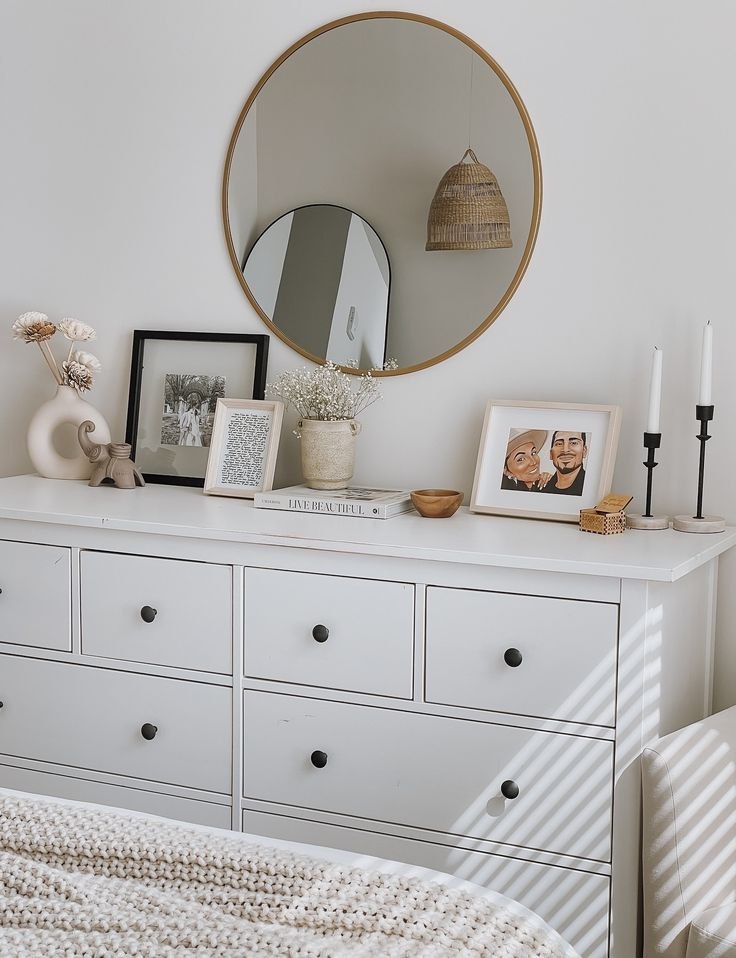
Every home has one surface that quietly becomes a junk magnet, and in the bedroom it’s the dresser top. Keys, receipts, a water glass, three lip balms, the watch you meant to put away — the dresser absorbs it all, and somehow still has to look like part of a restful room. Decorating a bedroom dresser is really the art of negotiating peace between your daily life and your decorating ambitions.
Stylists aren’t using magic objects. They’re using thirteen rules — about emptiness, height and corralling — that work on any dresser, in any style, mostly with things you already own. Here they are, plus three copy-exactly formulas.
The Framework Before the Rules
Three ideas underneath everything: leave about 40% of the surface empty (empty space is what makes the styled 60% readable), arrange objects in a triangle of heights (tall, medium, low), and divide the top into two zones — one for living (your daily things, contained) and one for looking (pure decor). Keep those three and decorating a bedroom dresser stops being a talent and becomes a checklist. Master the framework and decorating a bedroom dresser turns into ten quiet minutes.
Foundation Rules (1–4)
1. Empty it completely, then invite things back. Everything off, surface wiped. Objects return one at a time, on merit. Half of what was there will not make the cut — that pile is the reason the dresser looked messy, not the styling.
2. Set the anchor above it first. A mirror or artwork at about two-thirds the dresser’s width, hung low (bottom edge 4–6 inches above the surface). The top styling echoes the anchor; without it, everything floats. Sizing math lives in our master bedroom wall decor guide.
3. Corral the daily things on a tray. Perfume, watch, jewelry, the lip balm — on a tray they become a curated collection; off a tray they’re clutter. Same objects, different verdict. One tray, roughly the size of a hardcover book, in the “living zone.”
4. Give one side height. A lamp, a tall vase, or a stack that reaches upward on ONE end. Height on one side only — it creates the slope the eye wants to travel. Table lamps on dressers are underrated: warm light at hip height is the most flattering light in the room. Height placement is the unglamorous core of decorating a bedroom dresser.
Composition Rules (5–9)
5. Build the triangle. Tall element (lamp or vase), medium element (a plant, a stack of 2–3 books), low element (a dish, a candle, a small box). Sight-line goes high → mid → low. If your dresser arrangement looks “off” and you can’t say why, it’s almost always a missing height in this triangle.
6. Group in odd numbers. Threes and fives. A cluster of three objects reads as a composition; two read as a pair waiting for a third, four as a crowd. Count your groups; stylists do. Odd numbers are the arithmetic of decorating a bedroom dresser.
7. Stack flat, stand tall. Books horizontal in a low stack (they’re also a riser — put the small plant ON the books for free height), one vertical element for contrast. Flat stack + vertical vase is the oldest dresser geometry there is.
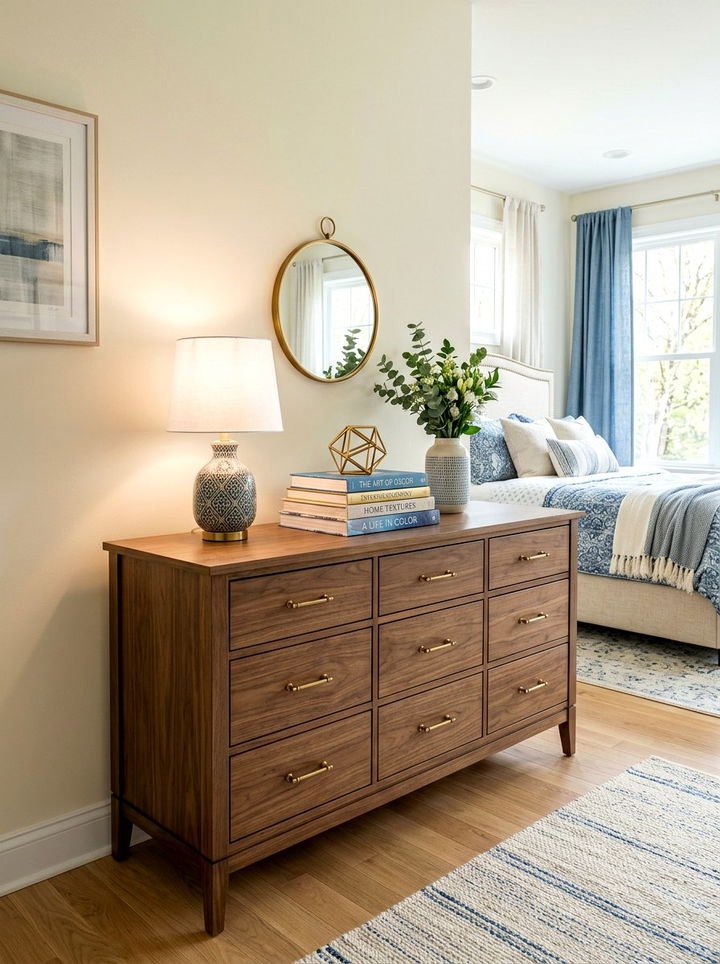
8. Mix three textures minimum. Wood + glass + metal, or ceramic + linen + brass. A single-texture dresser (all wood, all white ceramic) looks like a store display after closing. Texture is what makes it feel lived-in on purpose.
9. Add one living or once-living thing. A small plant (the forgiving list is in our indoor plants guide), a stem of eucalyptus in the tall vase, dried grasses. One green note wakes up everything around it. One green note does more for decorating a bedroom dresser than three more objects.
Life-Proofing Rules (10–13)
10. Designate the landing strip. Real life will land on this dresser daily — so assign it a parking spot: the tray, or one small bowl by the edge. Mess with an address doesn’t spread. This single rule is what keeps a styled dresser styled past Tuesday.
11. Put scent on the dresser. A candle or reed diffuser near the door side. The dresser is usually the first surface the room’s air reaches, and scent is the layer guests notice before they can name anything visual.
12. One personal object with a story. One framed photo, the bowl from a trip, the inherited clock. ONE. A dresser covered in twelve frames is a shrine; a single story-piece is a personality. Choose the one you’d save.
13. Reset in five minutes, edit every season. The styled dresser survives by maintenance, not by willpower: a 5-minute Sunday reset (everything back to its zone), and one object swapped per season so the surface never goes stale to your own eyes. Maintenance, not shopping, is the long game in decorating a bedroom dresser.
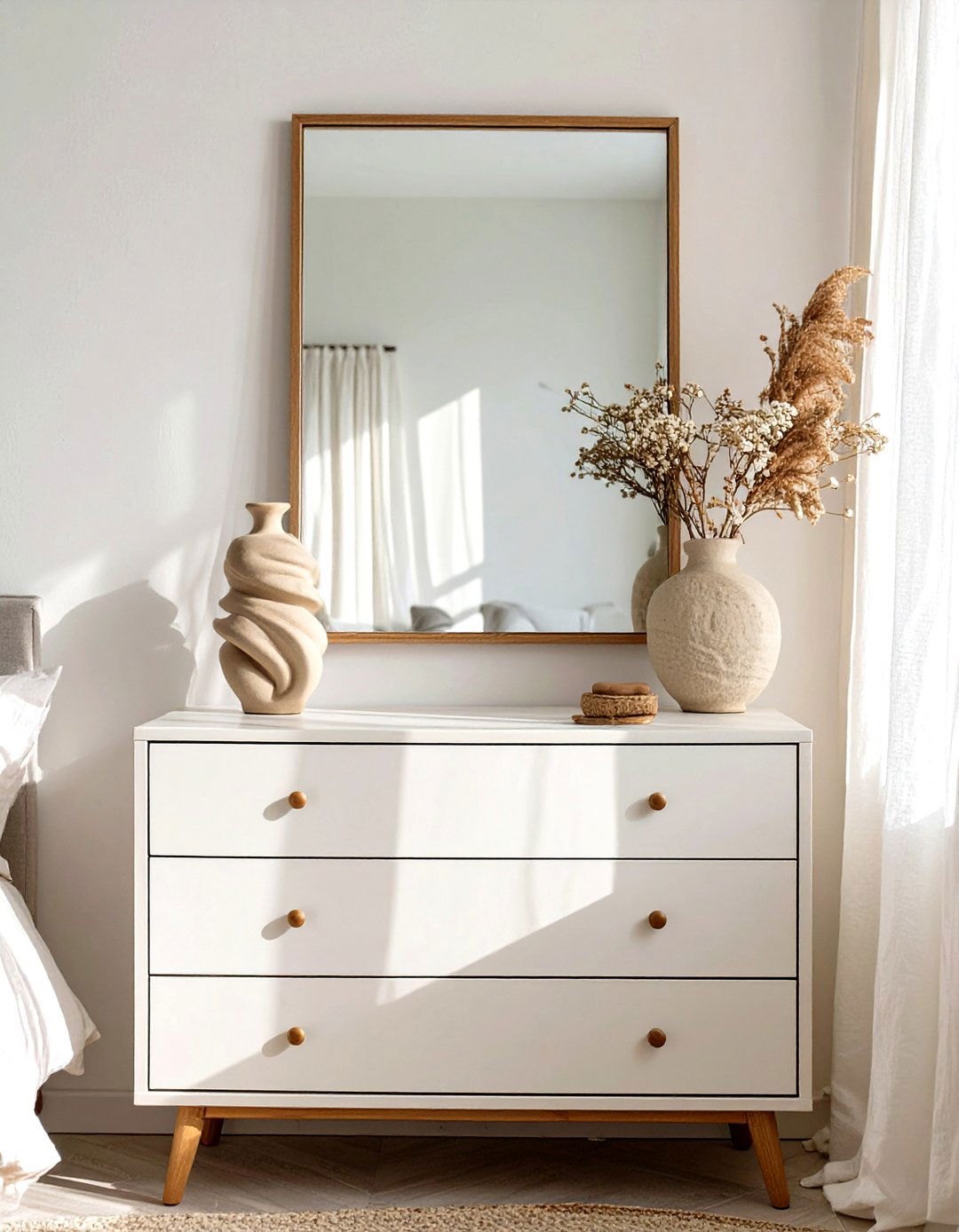
3 Ready Formulas (Copy These Exactly)
Calm Minimal (~$25). Round mirror above + tray (thrifted brass) with 3 bottles + small trailing plant + one low ceramic dish. Best with light wood dressers; the “after” photo of every decluttering video lives here.
Romantic Vintage (~$45). Ornate framed art above + lamp with a warm shade + lace runner under a stack of clothbound books + dried roses in a glass vase + the story object. Pairs with the mood of our gothic bedroom guide, minus the darkness.
Modern Budget (~$60). Big simple mirror + black tray + two art books + a sculptural candle + a snake plant in a matte pot. Most starter pieces come from the same big-box run (this is an IKEA-and-thrift formula at heart). Clean lines forgive cheap materials. Of the three formulas, this is decorating a bedroom dresser at its most forgiving.
3 Mistakes That Make Dressers Look Chaotic
Everything in a line against the wall. Pull pieces forward at different depths — front-middle-back. A lineup is a police lineup; depth is what makes it a scene.
Too many small things. Nine tiny objects < one medium + one small. Small things multiply visually; swap quantity for scale.
Blocking the function. Decor sitting where drawers open, the mirror hung so high you can only see your forehead, perfume in direct sun slowly cooking. Decorating a bedroom dresser ends at the edge of its job: it still has to dress you.
Frequently Asked Questions
How much stuff should be on top of a dresser?
Enough to fill about 60% of the surface with styled groupings, with the rest visibly empty. In object terms, most dressers carry 5–9 pieces well: an anchor above, a lamp or tall vase, a tray of daily things, one stack, one plant, one or two small accents. More than that and the eye stops reading groups and starts reading inventory — that’s the tipping point decorating a bedroom dresser is designed to avoid.
What if there’s a TV above the dresser?
Keep the styling low and wide: a long low tray, a horizontal book stack, one plant at the far end. Nothing tall that competes with the screen, nothing centered that fights it. Treat the TV as the anchor and style the flanks asymmetrically — tall on one side only.
Mirror or art above a dresser?
Mirror if the dresser doubles as your getting-ready station or the room is dark (it returns light and doubles as the functional mirror). Art if there’s already a mirror nearby or the dresser is purely storage. Both follow the same two-thirds-width rule, and either beats a bare wall.
How do you style a very long dresser?
Two zones, two compositions, one bridge. Style the left third and right third as separate small triangles, then connect them with one long low element — a runner, a row of three candles, a horizontal stack. A long dresser styled as one spread-out scene always looks sparse in the middle.
The Bottom Line
Decorating a bedroom dresser isn’t about owning prettier things — it’s about emptier space, honest triangles and giving your daily clutter a tray-shaped home. Empty it, anchor it, corral it, and reset it on Sundays. The dresser you already own is about twenty minutes from being the best-looking surface in the room. That’s the quiet reward of decorating a bedroom dresser properly.
For the full room sequence, see how to decorate your bedroom — dresser styling is Step 8. More surfaces and walls in the bedroom decor collection.