
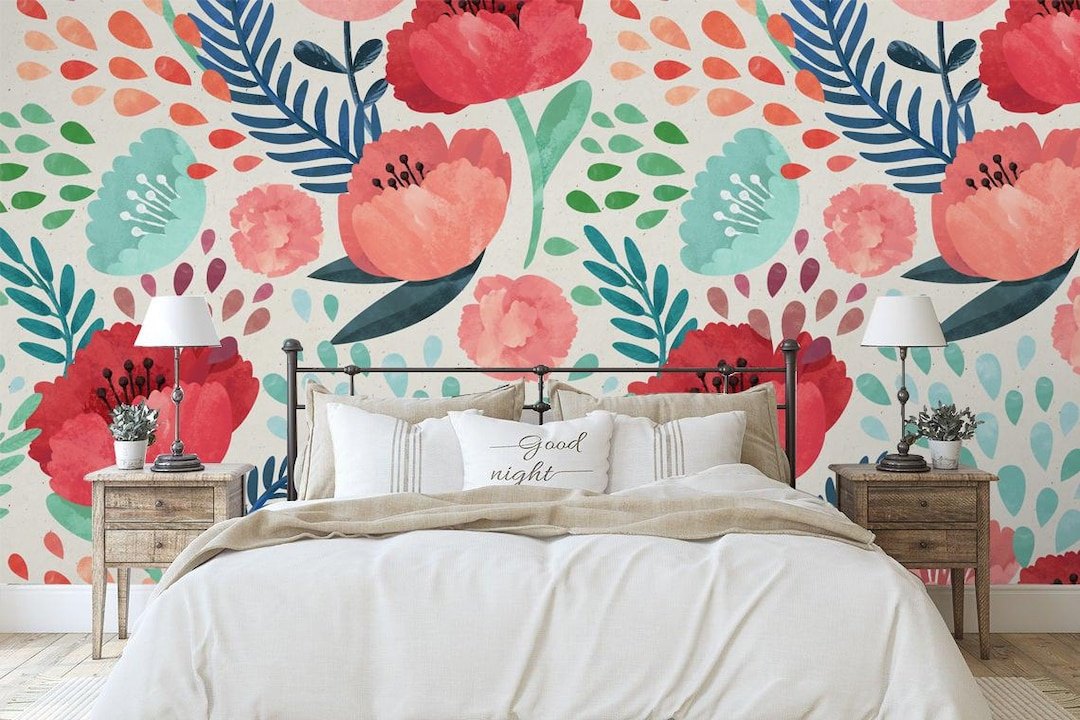
Paint is wonderful, but paint is flat. It can’t give you peonies climbing behind the bed, or the texture of linen on the wall, or a mural that makes a plain box room feel like it has a view. Wallpaper can — and peel-and-stick wallpaper removed the two things that used to make it a nightmare: the paste bucket and the permanence. Bedroom wallpaper decor is now a weekend project with an undo button.
Fifteen ideas below, from the classic accent wall to doses so small a landlord would never notice. But first, the part the product photos skip: the real math, the real costs, and the walls this stuff honestly fails on. Done right, bedroom wallpaper decor is the highest-impact afternoon a bedroom can have.
Before You Buy: The Math and the Honest Warnings
The math. Measure your wall: width × height in feet = square feet. A typical peel-and-stick roll covers about 25–30 sq ft (check the label — it varies wildly). Divide, add 15% for pattern matching and mistakes, round UP, and order every roll at once: reorders can arrive in a different dye lot and the mismatch will haunt you. Worked example: a 12 ft × 8 ft headboard wall = 96 sq ft → about 4 rolls at 28 sq ft each, +15% → still 4 rolls if you’re careful, 5 if the pattern is large. At $30–45 a roll (the range you’ll see at places like Lowe’s or on Etsy), one accent wall lands at $120–200 — against $400+ for traditional paper and a professional installer.
The warnings, honestly. Peel-and-stick fails on heavily textured walls (light orange-peel is borderline; knockdown and popcorn are no), on paint less than 3–4 weeks old (it will peel the paint off WITH the paper), and in steamy, unventilated humidity. Dusty or glossy walls need a wash and dry first. And always — always — hang ONE test strip for a week before committing: some papers shrink, curl or fall, and you want to learn that with one strip, not seven.
The Accent Wall Classics (1–3)
1. Botanical or floral behind the bed. The look that launched a thousand rentals: oversized peonies, eucalyptus or watercolor blooms on the headboard wall only, calm bedding in front. Scale rule: the bigger the room, the bigger the flowers can be. This is the entry point to bedroom wallpaper decor for a reason.
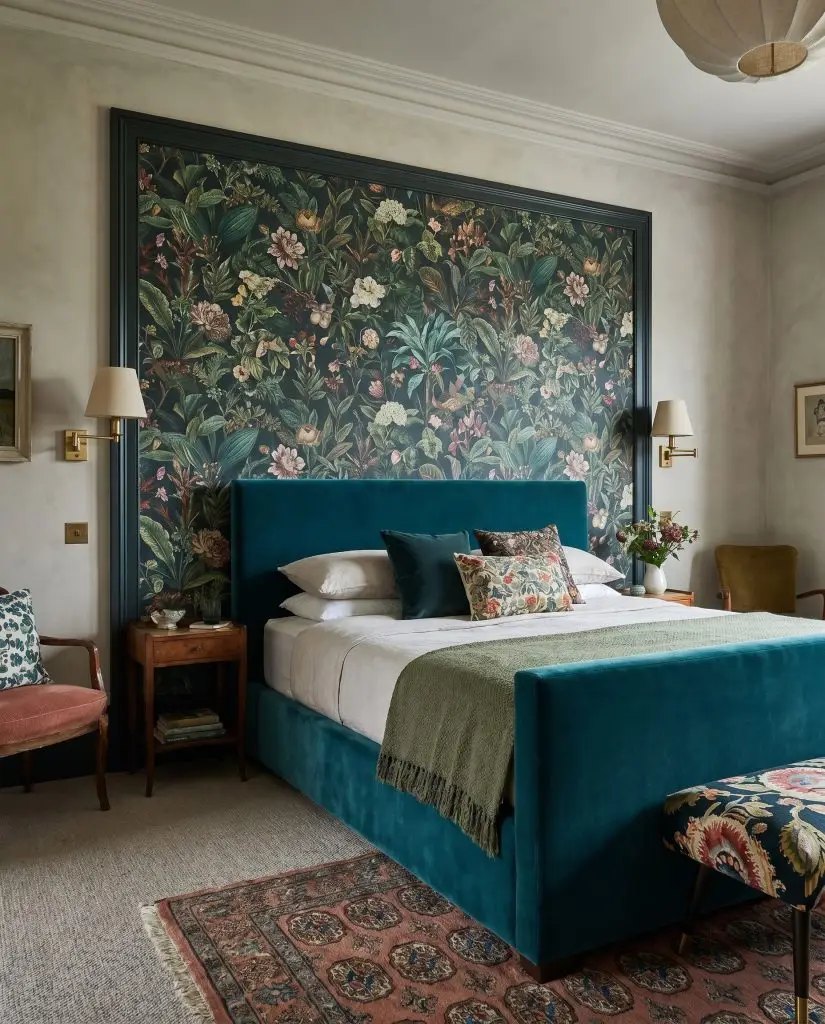
2. Moody and dark. Charcoal damask, deep green forest scenes, near-black florals — the wall from our gothic bedroom guide, delivered by paper instead of paint. Dark paper is more forgiving than dark paint: the pattern hides the brush marks you’d otherwise see.
3. Texture without pattern. Grasscloth-look and linen-look papers in oatmeal or greige. All of wallpaper’s warmth, none of the visual noise — the neutral-bedroom move in bedroom wallpaper decor (it pairs perfectly with the palettes in our neutral bedroom guide).
The Headboard Illusion (4–5)
4. A papered panel framed with trim. Paper only the rectangle behind the bed, edge it with thin peel-and-stick molding or painted wood strips, and it reads as architecture — a designed headboard wall for the price of two rolls.
5. The arch. An arched panel of paper (trace it, cut it, hang it) centered on the bed. Arches soften boxy rooms and photograph like a boutique hotel. Renters: this is a one-roll project, and one of the smartest small-scope moves in bedroom wallpaper decor.
Beyond the Accent Wall (6–8)
6. The ceiling — the fifth wall. A soft, low-contrast pattern overhead (small stars, clouds, a pale trellis) turns lying in bed into the best view in the house. Keep it light; ceilings punish dark choices. Overhead is the most overlooked frontier in bedroom wallpaper decor.
7. The closet or nook interior. Paper inside an open closet, a reading nook or the wall behind a desk tucked in the bedroom. Small square footage, huge personality — and a gentle training ground before your first big wall.
8. Behind shelves and the dresser. Paper the wall section behind open shelving or the dresser vignette. The pattern becomes a backdrop that makes ordinary objects look styled.
Small Doses, Zero Commitment (9–11)
9. Framed wallpaper panels as art. Buy ONE roll (or a $10 sample sheet) of the expensive paper you love, frame two or three panels, hang as a series. Ninety percent of the look, five percent of the cost and effort.
10. Wardrobe doors and drawer fronts. Flat furniture fronts take paper beautifully and turn storage into the room’s pattern moment. Fully reversible with heat and patience.
11. The strip you see from the bed. Paper just the wall your eyes land on when you wake — even a partial-height wainscot-style band. Decorating the view FROM the bed, not just behind it, is the insider move in bedroom wallpaper decor.
Match the Pattern to the Room (12–14)
12. Small bedroom: light ground, small-to-medium pattern. Busy isn’t the enemy — dark and oversized is. A pale paper with a delicate repeat keeps the air in the room.
13. Low ceiling: vertical energy. Stripes, climbing vines, anything that walks the eye upward. Avoid horizontal bands, which press the ceiling down.
14. Dark or north-facing room: a little metallic. Papers with gold, copper or pearl threads catch what light exists and hand it back. Matte dark paper in a dark room just eats the day. Light management is half of bedroom wallpaper decor, honestly.
The Renter Special (15)
15. The full temporary mural. Modern photo murals come in peel-and-stick panels: a misty forest, a marble expanse, a vintage map. It’s the boldest version of bedroom wallpaper decor and it peels off at move-out — photograph your walls before and after, keep the backing sheets for storage, and your deposit never knows.
Install in 7 Steps (Two People, Two Hours)
Tools: smoothing tool or credit card, sharp utility knife with spare blades, level or plumb line, step stool, a friend. 1. Wash the wall, let it dry fully. 2. Mark a plumb vertical line for the first strip — walls are never straight; paper must be. 3. Peel back only the top 12 inches of backing. 4. Align, stick the top, smooth downward in the center then out, peeling as you go. 5. Butt seams tightly (most papers shrink a whisper — a hairline overlap per the maker’s instructions). 6. Squeegee bubbles toward edges; pop stubborn ones with a pin. 7. Trim top and bottom with a fresh blade. First strip slow, rest fast — by strip three you’ll feel like a professional.
Removal: The Honest Truth
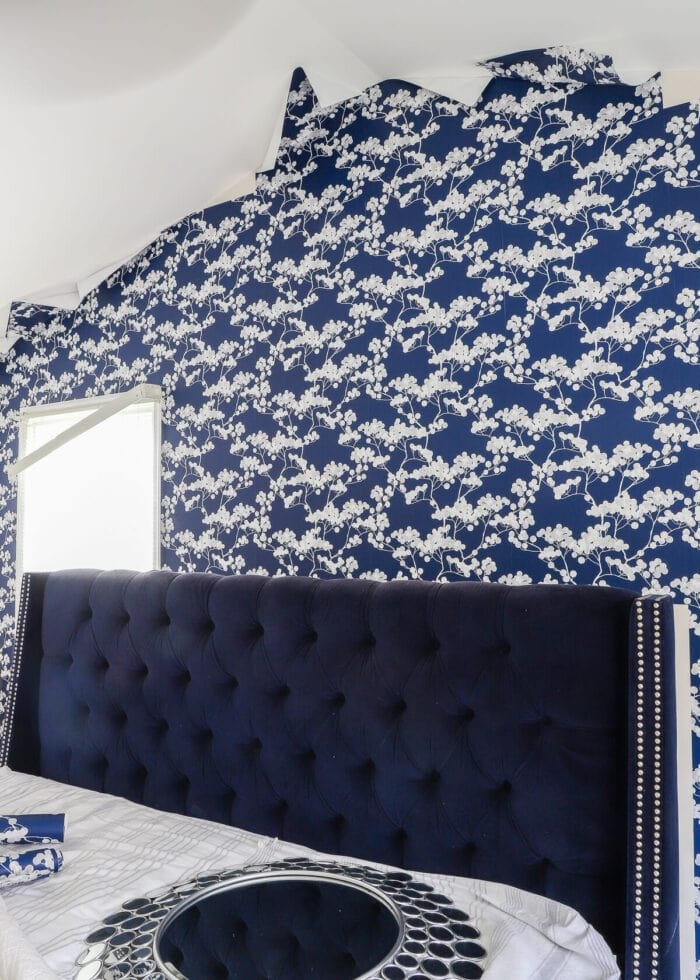
Good peel-and-stick, on a suitable wall, comes off cleanly: start a corner, peel back slowly at a low angle, warm stubborn spots with a hairdryer. Residue (rare) yields to warm soapy water. The horror stories almost always trace back to the warnings section: fresh paint, textured walls, steam. Buy brands that publish removal testing, save one leftover roll for repairs, and the “undo button” is real.
4 Mistakes That Waste Rolls
Ordering rolls in two batches. Dye lots differ. One order, all rolls, plus your 15%.
Skipping the test strip. A week of patience saves a wall of regret — papers behave differently in every home’s light and humidity.
Choosing the worst wall. The textured, sun-blasted, or freshly painted wall is not where your first project belongs.
Pattern too big for the room. A giant repeat in a tiny bedroom shows you two flowers and a lot of awkward cuts. Match scale to space (idea 12).
Frequently Asked Questions
How much does it cost to wallpaper one bedroom wall?
For a standard 12×8 ft wall in peel-and-stick: about $120–200 in paper (4–5 rolls) plus $15 in tools you likely own. Traditional pasted paper with professional installation typically starts around $400 for the same wall. Bedroom wallpaper decor in peel-and-stick form is roughly a third of the old cost — and free to remove.
Does peel-and-stick wallpaper damage walls?
On smooth, properly cured paint (at least 3–4 weeks old) from a reputable brand: no — it peels cleanly. Damage stories almost always involve fresh paint, heavy wall texture, or very cheap paper with aggressive adhesive. The one-week test strip tells you which kind you bought before the whole wall is at stake.
Can peel-and-stick go over existing wallpaper or paneling?
Over smooth, well-bonded existing wallpaper: often yes, after a wash and test strip — though seams can telegraph through. Over paneling grooves or textured surfaces: no; the adhesive can’t bridge the grooves and edges will lift. In those cases, paper a different wall or use the framed-panel idea instead.
How long does peel-and-stick wallpaper last?
On a suitable wall, years — five or more is common in low-traffic, low-humidity bedrooms. Edges near heat sources or in steamy ensuite bathrooms age fastest. Keep the spare roll and a repair strip; small lifts can be re-smoothed or patched invisibly. With sane expectations, bedroom wallpaper decor earns its reputation as the reversible upgrade.
The Bottom Line
Bedroom wallpaper decor used to be a vow; peel-and-stick made it a date. Do the math, respect the warnings, test one strip, and give the wall behind your bed the pattern paint never could. If it thrills you for five years, wonderful. If your taste changes in two, peel, photograph, and begin again — that’s not a flaw of the product, it’s the entire point.
Wallpaper is Step 4 in our full bedroom decorating guide; if pattern isn’t your path, the cozy paint colors guide is the flat-but-lovely alternative. More ideas in the bedroom decor collection.