
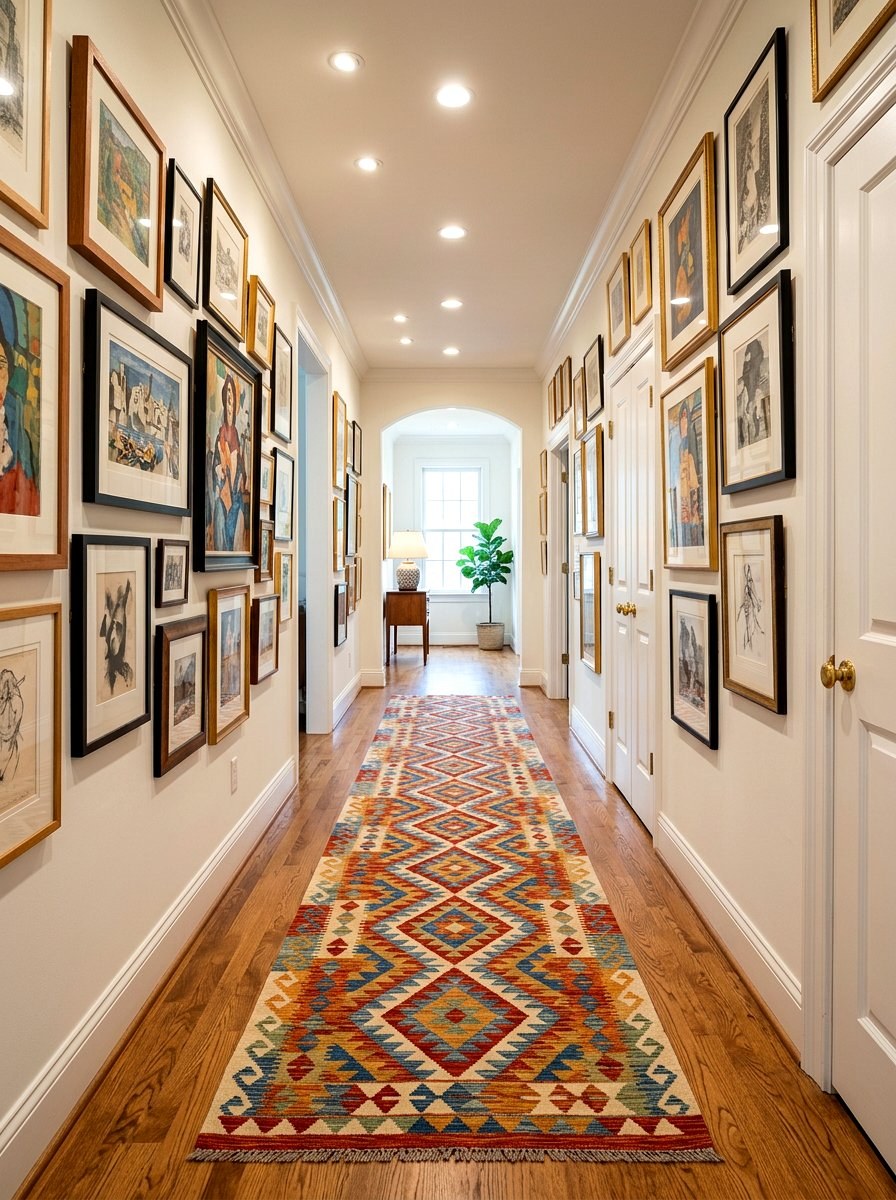
For two years, my hallway was just the place shoes went to die. Beige walls, one sad ceiling light, a pile of mail that migrated daily. Then I found a faded kilim-style runner at a thrift store for $18, unrolled it, and the whole apartment suddenly felt intentional. That runner is why I now believe cheap hallway decorating ideas beat expensive room makeovers, dollar for dollar — the hallway is the one space every guest walks through, and it takes almost nothing to fix.
Here’s the full playbook of cheap hallway decorating ideas: the runner sizing math nobody tells you, the mirror and lighting tricks that rescue dark hallways, gallery wall formulas that work in 36 inches of width, storage that hides in plain sight, and three honest budget tiers — $10, $25 and $50. Pick your tier and your hallway stops being a pass-through by Sunday.
Why Cheap Hallway Decorating Ideas Work So Well (Hallways Are Forgiving)
A hallway is the easiest space in your home to make look good, for one simple reason: nobody lingers in it. There’s no sofa to anchor, no TV wall to solve. A hallway is basically three surfaces — floor, walls, ceiling light — and if you improve two of the three, the space reads as “done.”
That’s also why cheap hallway decorating ideas punch above their weight. The square footage is tiny. A runner covers most of the floor for $30. One can of spray paint unifies ten thrifted frames. The most expensive mistake people make here isn’t cheap materials — it’s treating the hallway like leftover space and spending $0 of thought on it. It’s the same principle behind our whole economy home decor approach: small spaces, small money, deliberate choices.
Step 1: The Runner — With the Sizing Math Nobody Prints
Start with the floor. Of all cheap hallway decorating ideas, this is the one to get right first. A runner is 60% of a hallway makeover by itself, and it’s where most people quietly go wrong: they buy whatever size is on sale, and it looks off forever without them knowing why. Here’s the actual math, the same rules rug retailers use (Rugs Direct’s runner sizing guide lays it out the same way).
Width: your runner should leave 4 to 6 inches of bare floor on each side. Measure your hallway width, subtract 10 inches, and round to the nearest standard width. A standard 36-inch hallway takes a 26-inch runner. A 40-inch hallway takes a 30-inch one. Standard widths are 24, 26–27 and 31–32 inches — never wider than the hall minus 8 inches total, or it reads as sad wall-to-wall carpet.
Length: aim for about 90% of the hallway’s length, with 6 to 12 inches of bare floor at each end. A 10-foot hallway wants an 8- or 9-foot runner. A 12-foot hallway wants a 10-foot runner. If your hall is longer than 14 feet, two shorter runners with a small gap usually look better (and cost less) than one extra-long one.
Door check: open every door that swings into the hallway. If a door drags on the rug, end the runner short of that door or switch to a flatweave under 1/4 inch thick. This is the mistake that makes people rip runners out in week two.
What to buy: a washable flatweave or low-pile runner, 2×8 or 2×10, runs $25–$45 at IKEA, Amazon or Target — my thrifted one was $18, and vintage-look patterns hide hallway dirt better than any solid. Add a $8 non-slip pad. Not optional. A sliding runner in a dark hallway is a hospital bill with free shipping.
Step 2: Fix the Light Before You Buy Anything Else
Most hallways have exactly one ceiling fixture with a bulb from the previous decade, and then we wonder why the space feels like a tunnel. Light is the cheapest hallway decorating idea on this list, because half of it is just buying the right bulb.
The bulb swap ($5–$7): replace whatever’s up there with an LED bulb rated 800 lumens or more, in 2700K–3000K (warm white). Skip anything labeled “daylight” 5000K — in a windowless hallway it reads as dentist-office blue, and it will fight every warm tone in your runner and frames. If your fixture has a dark or frosted shade that’s eating the light, a clear glass replacement shade is about $9 and can nearly double what reaches the walls.
Battery picture lights ($14–$18): this is the trick designers use and nobody expects in a budget guide. A rechargeable picture light mounted over a frame or mirror adds a pool of warm light mid-hallway, exactly where the ceiling light gives up. No wiring, no electrician, charges by USB.
Puck lights and motion lights ($10–$13 for a 3-pack): stick-on LED pucks under a floating shelf, or a plug-in motion-sensor light near the floor for nighttime. In a truly dark hallway, one motion light at the far end changes the whole walk from “cave” to “hotel corridor.” Together, these three layers cost under $35 — proof that the best cheap hallway decorating ideas are usually about light, not stuff.
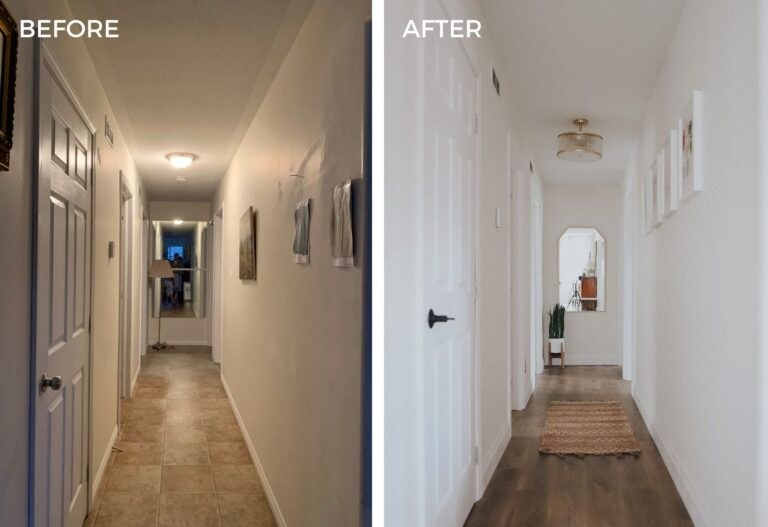
Step 3: The Mirror Trick (One Mirror, Placed Right)
A mirror is the oldest hallway trick there is, and it still works — but placement is everything. Hang the mirror on the wall opposite or adjacent to your light source (a doorway into a bright room counts), so it catches and throws that light down the hall. A mirror hung in the darkest middle stretch, facing another dark wall, reflects… a dark wall. I’ve made this mistake so you don’t have to.
Size rules: in a narrow hallway, one round mirror around 24 inches across beats a skinny rectangle — the curve softens all those straight lines, and 24 inches leaves comfortable margin in a 36-inch-wide hall. Thrift stores price mirrors absurdly low: $8–$15 for sizes that run $40+ new, because nobody wants to haul them. A $6 can of matte black or antique gold spray paint makes a dated frame match your gallery wall (more on that below).
One mirror, placed right, does more than any single item on this list of cheap hallway decorating ideas. Hang the center at about 57–60 inches from the floor — standard gallery height — and if the hallway is also your entryway, that mirror earns its keep twice: last-check-before-leaving duty. One warning: two mirrors facing each other in a narrow hall creates that infinite-funhouse tunnel. One is a trick. Two is a headache.
Step 4: Cheap Hallway Decorating Ideas for the Walls — Gallery Formulas That Fit
The gallery wall is the most-searched hallway upgrade for a reason, and it’s genuinely cheap if you source it the thrift way: mismatched frames, $1–$3 each, filled with prints you already own, calendar art, fabric scraps or free printable art. The $6 can of spray paint in one color is what turns ten random frames into a collection. This is the single highest-impact of all the cheap hallway decorating ideas here for anyone whose walls are currently bare.
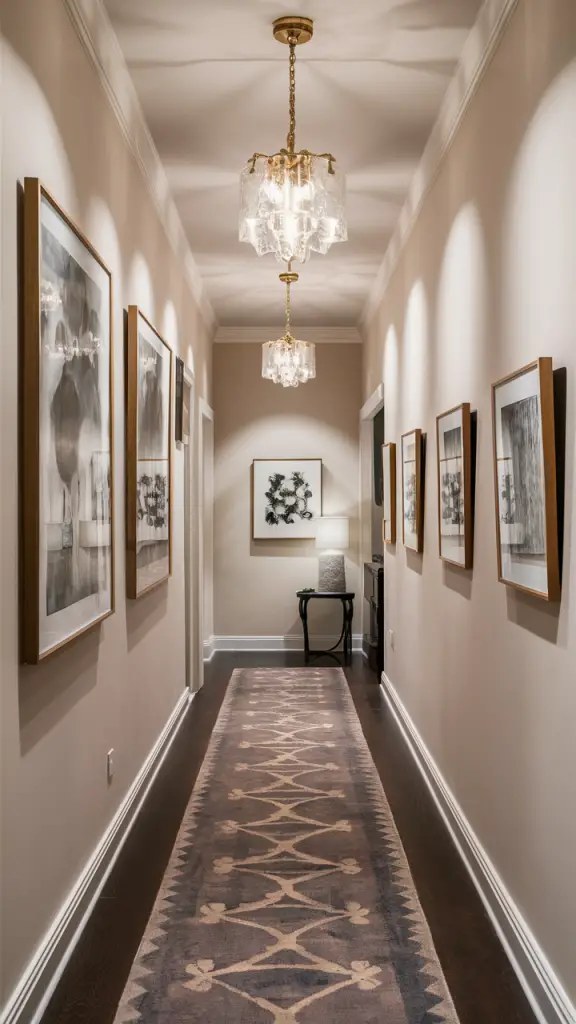
Now the part the pretty photos skip: the measurements.
Formula 1 — The Center Line (best for long halls): hang every frame so its center sits on one invisible line at 57 inches from the floor, spaced 2 inches apart. Sizes can jump around freely; the shared center line keeps it calm. Total cost for a 6-frame run: about $15–$20 thrifted.
Formula 2 — The Two-Row Grid (best for short, wide-ish halls): same-size frames (8×10s are cheapest), 2 rows, 2-inch gaps everywhere, hung as one block. Six matching frames new at IKEA run about $12 total. A grid reads modern and tidy, and it’s the easiest layout to expand later.
Formula 3 — The End-Wall Statement (best for dead-end halls): skip the long walls entirely and put one oversized piece — a $10 poster in a $9 frame, a thrifted mirror, a woven wall hanging — on the wall you walk toward. It gives the hallway a destination. This is also where a seasonal piece works beautifully; I rotate mine using the same prints from our fall home decor on a budget setup.
Renter rules: use Command strips rated for the frame’s actual weight (check the pack — a large strip pair holds up to 16 lb, but glass-fronted frames are heavier than they look, so weigh on a kitchen scale if you’re unsure). Map the whole layout in painter’s tape first and live with the tape for a day. And if you want more whole-home wall strategy beyond the hallway, the sizing logic in our master bedroom wall decor guide transfers directly.
Step 5: Storage That Looks Like Decor (The Entryway End)
If your hallway starts at the front door, it has a second job: catching everything you carry in. Storage is where cheap hallway decorating ideas stop being decoration and start paying rent. The rule that keeps storage from becoming clutter is walkway math — an adult needs about 24 inches of clear path to walk comfortably (and more with a laundry basket). In a 36-inch hallway, that caps anything on the floor at 10–12 inches deep. In a 30-inch hallway, floor furniture is off the table entirely; go vertical.
What fits: a wall hook rail ($10–$14) at 60 inches high for bags and hats; IKEA Trones shoe cabinets ($40 for a pair, only 7 inches deep) if your width allows; a floating shelf no deeper than 8 inches ($12) with a small tray ($5) as a key-and-mail drop zone; one lidded basket ($7) under it for the stuff that has no home. Label-free, lid-on storage is the whole secret — open piles read as mess, the same items in a closed basket read as decor.
What doesn’t fit, whatever Pinterest says: benches in hallways under 42 inches wide, coat trees (they eat a 24-inch circle of floor), and any console table deeper than 12 inches. I’ve bruised my hip on a “slim” 14-inch console in a 36-inch hall. The math is the math.
Pick Your Tier: $10, $25 or $50
Here is every one of these cheap hallway decorating ideas, sorted by what it actually costs to start. This is exactly how I’d spend it, in order.
| Tier | Buy this | Skip for now |
|---|---|---|
| $10 tier | Warm 800-lumen bulb ($6) + 3 thrifted frames ($1 each) + use prints you own. Fixes light + starts the gallery line. | The runner — save up rather than buying the thinnest one. |
| $25 tier | Everything in $10, plus spray paint to unify all frames ($6) and a battery picture light over the best frame ($15). The hallway now looks designed, not assembled. | A mirror — thrift one later when the right size appears. |
| $50 tier | Everything in $25, plus a washable 2×8 runner ($30 on sale) — or the runner first ($30) + thrifted mirror ($12) + bulb ($6) if your walls already have art. | Matching retail frame sets and peel-and-stick wallpaper for the whole hall. |
7 Hallway Mistakes That Waste Money
After testing plenty of cheap hallway decorating ideas in a 36-inch hall, these are the seven I’d warn anyone about first.
1. Buying the runner wall-to-wall. No bare-floor border = instant carpet-store look. Minus 10 inches from the width, always.
2. Painting a dark hallway a dark “moody” color before fixing the light. Moody works with layered light. With one weak ceiling bulb, it’s just a darker tunnel. Bulb first, paint second — or skip paint entirely.
3. Hanging frames at standing-eye height of the tallest person in the house. Gallery center is 57 inches. Hung at 65+, art floats over everyone’s sightline and the wall still looks empty.
4. Skipping the non-slip pad. Already said it, saying it again. $8. Non-negotiable.
5. Cool-white bulbs. 5000K “daylight” bulbs make every hallway feel like a parking garage. 2700K–3000K, every time.
6. A gallery wall with no unifier. Mixed frames are fine — mixed frames, mixed mat colors, mixed art styles and random spacing is visual noise. Pick one unifier: frame color, mat color, or the center-line formula.
7. Ignoring the end wall. The wall you walk toward is the hallway’s focal point, and most people leave it blank while decorating the sides. One piece there outperforms six along the sides.
Frequently Asked Questions
What is the cheapest way to decorate a hallway?
Swap the ceiling bulb for a warm 800-lumen LED (about $6) and hang a center-line gallery of thrifted frames unified with one can of spray paint (about $15–$20 total). Those two moves fix light and walls — two of the hallway’s three surfaces — for under $25 combined.
How wide should a hallway runner be?
Leave 4 to 6 inches of bare floor on each side: measure the hallway width and subtract about 10 inches. A 36-inch hallway takes a 26-inch runner; a 40-inch hallway takes a 30-inch runner. For length, cover roughly 90% of the hall with 6 to 12 inches bare at each end.
How do you decorate a dark hallway with no windows?
Layer light instead of chasing one bright fixture: a warm high-lumen ceiling bulb, a battery picture light over art, and a motion-sensor light at the far end. Add one mirror opposite a doorway or light source to bounce what light you have, and keep the runner and art in lighter, warmer tones.
Are these hallway ideas renter-friendly?
Yes — everything here is reversible. Runners and bulbs need no permission at all, gallery walls hang on Command strips, battery picture lights stick or screw into the frame rather than the wall, and hook rails can mount to a door instead. Nothing in the $10 or $25 tiers touches paint or wiring.
What color makes a narrow hallway look bigger?
A warm light neutral on the walls plus a runner with a lighter center and darker border — the border “frames” the path and makes the floor read wider. But honestly, lighting temperature moves the needle more than paint color: swapping to 2700K–3000K bulbs makes the same beige walls look intentional instead of dingy.
How much does it cost to decorate a hallway?
A real transformation lands between $25 and $50 using the tiers above. Under $10 fixes light and starts a gallery wall; $25 unifies everything; $50 adds the runner, which is the single biggest visual change. Hallways are small — there is no version of this that needs $200. That’s exactly why cheap hallway decorating ideas are my favorite place to start a budget home.
The Bottom Line
Your hallway is the hardest-working square footage in your home and the cheapest to fix. Start with the bulb, run the runner math before you buy, unify a handful of thrifted frames on a 57-inch center line, and give the end wall one good piece. That’s the whole system — and most of it is done for the price of two takeout coffees. Save this list of cheap hallway decorating ideas and work down it tier by tier.
If you’re working through your whole home on the same logic, the hallway slots neatly into the room-by-room tiers in our economy home decor pillar, and the full Budget Home Decor category has the rest of the rooms waiting. Your hallway goes first, though. It has waited long enough.