
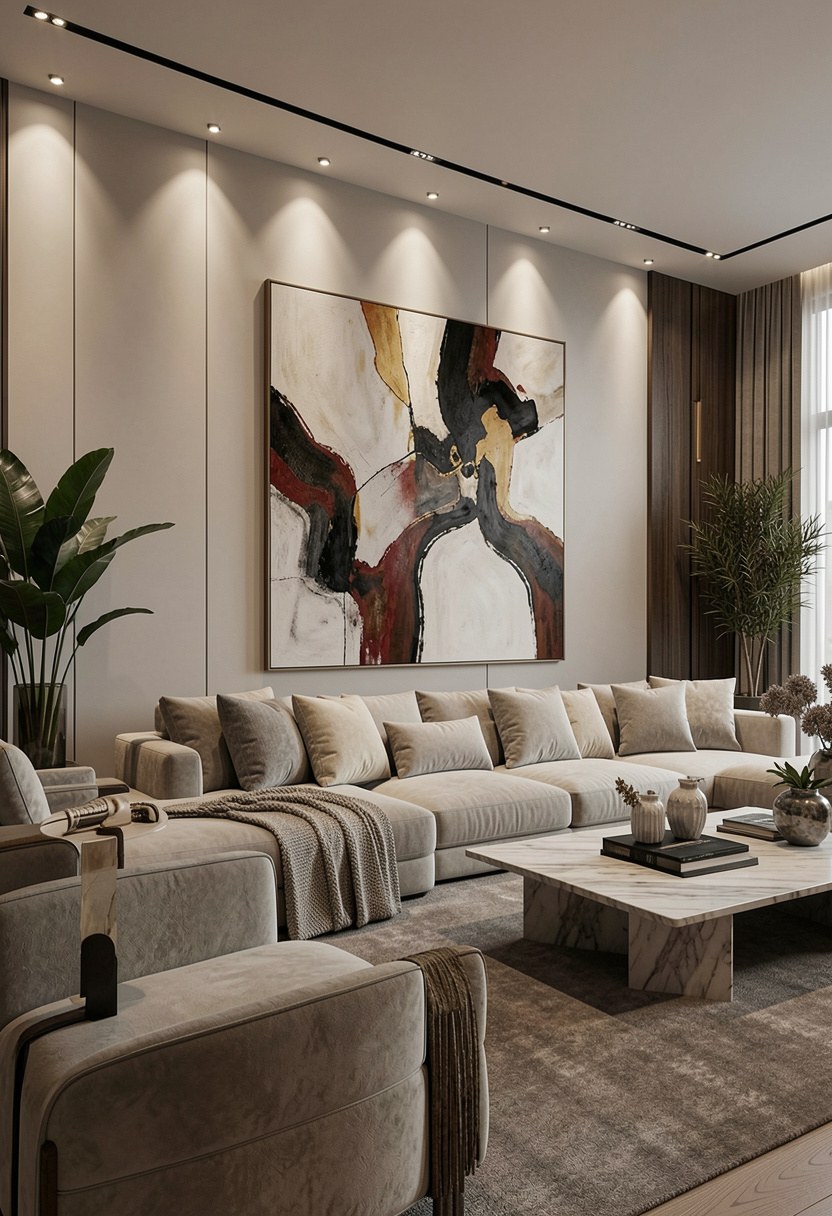
I learned the size lesson the expensive way. I ordered a canvas online that was advertised as “extra large,” paid $129 for it, and unboxed a 24×36 print that absolutely vanished over my 96-inch sofa. It looked like a postage stamp stuck on an envelope. Returning it cost me another $38 in shipping. The replacement? A 36×48 engineer print that cost $11, in a thrifted frame that cost $9.
That’s the trap with large wall decor ideas on a budget: at this scale, the price tag and the size have almost nothing to do with each other. A $129 canvas can be physically small, and an $11 print can be genuinely huge. So this guide ignores price-first shopping completely. Everything here is organized by finished size — what a 24×36, a 40×60 and a 60×90 statement actually costs, method by method.
One boundary before we start: this article is about ONE big statement per wall, in the living room. If you want to cover a wall with many smaller pieces, our cheap wall decor ideas guide prices those methods per square foot and does the gallery math. Here, we go big or go home — one piece, properly sized. And bedroom statement walls get one hand-off at the end, because they play by different rules.
Large Wall Decor Ideas on a Budget Start With Scale, Not Shopping
Every failed big-wall project I’ve seen — mine included — failed on size, not taste. The piece was fine. It was just 40% too small for the furniture under it, so it read as an accident instead of a decision. Fix the size first and almost any cheap method looks intentional.
The two-thirds rule. Art above furniture should span roughly 60–75% of the furniture’s width. Here’s the math for the sofas people actually own:
| Sofa width | Art width you need | Finished size to shop |
|---|---|---|
| 72 inches | 43–54 inches | One 40×60 turned sideways, or a 3-panel set spanning ~48 in |
| 84 inches | 50–63 inches | One 40×60, or a triptych spanning ~60 in |
| 96 inches | 58–72 inches | One 48×72 print, or a wide tapestry (60×80) |
| 120-inch sectional wall | 72–90 inches | 60×90 print, or two 36×48 pieces hung as a pair |
Height rules. Center the piece at 57–60 inches from the floor. Above a sofa, the bottom edge should sit 6–10 inches above the sofa back — close enough to feel connected, high enough that nobody’s head meets the frame. I tape the outline on the wall with painter’s tape and live with it for a day before anything gets printed. Tape is free. Reprints aren’t. Measure first, and large wall decor ideas on a budget stop being a gamble.
Stairwell walls. A staircase wall is a diagonal problem, so solve it diagonally. Hang your arrangement so it climbs parallel to the handrail: measure about 57 inches straight up from each tread’s front edge (the “nosing”) to find your centerline, and step the pieces up by roughly one riser height (about 7½ inches) per tread. Keep the bottom corner of every frame at least a hand’s width above the handrail line, and never hang glass on a stair wall — it’s the one wall in the house guaranteed to get bumped by a carried laundry basket eventually. Light canvas or textile only — the two kinds of large wall decor ideas on a budget that belong on a stair wall.
Two-story walls. Don’t chase the ceiling. A 24×36 floating at 14 feet doesn’t look grand, it looks lost. Treat the bottom 9–10 feet as the room — that’s the zone people actually see — and put your one big piece in it, centered over the furniture as usual. If the upper emptiness still bothers you, hang a long tapestry from a rod mounted at about 10 feet and let the fabric own the height. One tall textile beats five small frames stacked toward the ceiling, every time.
Get the scale right and large wall decor ideas on a budget almost pick their own method from the table below.
Large Wall Decor Ideas on a Budget, Priced by Finished Size
Here’s the table I wish existed when I was returning that canvas. These are realistic all-in costs — print, frame or hanging hardware, everything — for one finished piece at each size, based on the methods detailed below. For comparison, one retail canvas print at 60×90 typically runs $250–$600.
| Method | 24×36 in | 40×60 in | 60×90 in |
|---|---|---|---|
| Engineer print (black & white) + poster frame or hanger rails | ~$19 | ~$42 | ~$74 |
| Digital download + local poster print + thrifted frame | ~$17 | ~$39 | ~$68 |
| Tapestry / single textile panel* | ~$13 | ~$21 | ~$29 |
| DIY stretched canvas or drop cloth, painted by you | ~$21 | ~$34 | ~$52 |
| Split triptych (3 canvas panels from one image, sale pricing) | ~$36 (spans ~40 in) | ~$64 (spans ~54 in) | ~$98 (spans ~72 in) |
| Peel-and-stick mural panel | ~$36 | ~$79 | ~$139 |
*Tapestries come in their own sizes — roughly 51×59, 60×80 and 80×104 inches — which is exactly why they’re the coverage bargain of this whole list. Color engineer prints cost about 40% more than black & white. And one warning that applies to every row: at 40 inches and up, the frame or hanging method costs as much as the print. Budget for both or you’ll end up with a rolled poster in the corner, like I did for two months.
The 5 Methods Behind These Large Wall Decor Ideas on a Budget, Honestly Reviewed
Five methods do nearly all the work in large wall decor ideas on a budget. Here is each one with its real strengths and its honest weakness, in the order I’d try them.
1. Engineer prints: the $7 big print nobody believes
Office print shops sell oversized black-and-white prints on thin bond paper — “engineering prints” — for a few dollars even at 36×48. Photos with strong contrast, line art, vintage patent drawings and architectural sketches look genuinely sharp this way. The catch is the paper: it’s flimsy and curls. Mount it on a $6 sheet of foam board with spray adhesive, or clamp it in wooden poster hanger rails, and the curl disappears. No glass, no glare, almost no weight. Up close it looks like a poster, because it is one. From the sofa, eight feet away, it looks like art. For pure price per inch, it’s the hardest of these large wall decor ideas on a budget to beat.
2. Tapestries and fabric panels: the most wall per dollar, full stop
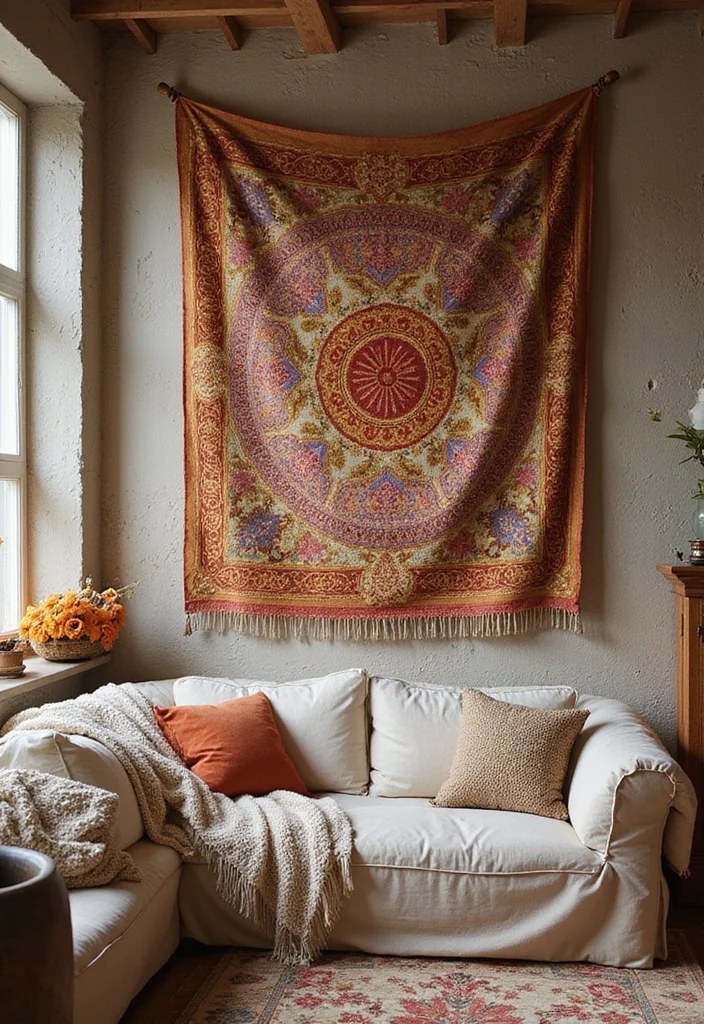
A 60×80 tapestry for about $21 covers 33 square feet. Nothing else in this article comes close. Hang it from a $4 dowel or a slim curtain rod so it reads as a textile panel, not a dorm-room flag. Steam it first — the packet creases are what make cheap tapestries look cheap. If the bottom hem waves, slide a thin dowel into the hem pocket as a weight. Patterns and woven-look prints forgive a lot of sins here; a tapestry with a crisp photographic print is the one version I’d skip, because fabric softens detail whether you want it to or not. It’s also the first method I suggest when someone asks about large wall decor ideas on a budget in a rental — nothing this light can damage a wall.
3. DIY stretched canvas and drop cloth: the weekend build
Stretcher bars, a staple gun, and either primed canvas or a painter’s drop cloth. A drop cloth is the cheat code at 60×90 — it costs about $12 for a piece that size, takes latex paint beautifully, and two or three colors swept on as a loose abstract honestly fool most guests. Bars at that size need a center brace or the whole thing bows like a potato chip; that’s a $2 strip of wood, not a reason to skip it. Total for the big one: around $52, most of it reusable tools. This is the most “real art” result on the list if you have a Saturday. The trade-off in these large wall decor ideas on a budget is time instead of money: two hours of your weekend rather than $200.
4. The split triptych: one image, three panels, gallery math
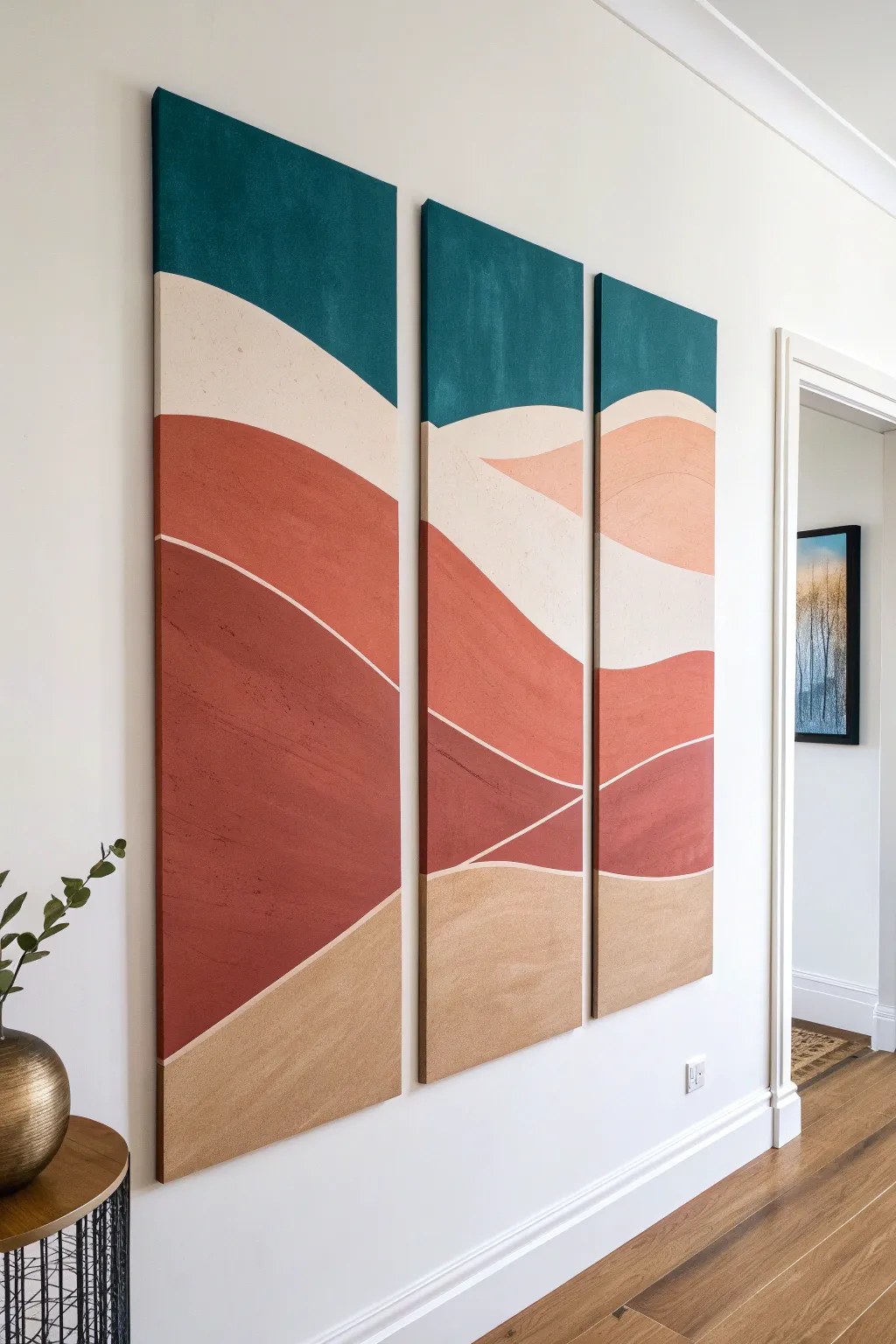
Take one high-resolution image, split it into thirds, and print each third on its own canvas panel. You get a 54–72 inch statement that ships flat, hangs light, and reads as deliberate gallery design. Two rules make or break it. First, hang the middle panel first, perfectly level, then match the other two to it with 1½–2 inch gaps — seams that drift by even a quarter inch will bother you daily. Second, pick an image with movement across the whole width (landscapes, abstracts, skylines). A portrait split across three panels just looks like a mistake. When it works, though, this is the entry among large wall decor ideas on a budget that photographs most like a design magazine. This is my pick for stairwell walls, by the way: three tall, light panels stepping up the rake, nothing heavy, nothing glass.
5. Thrifted frame + free museum art: the classiest cheap trick
Museums now give away high-resolution art files for free — the Smithsonian Open Access collection alone has millions of public-domain images at print-ready resolution, and it’s where I found the botanical print over my own desk. Download big, print it locally as a poster for a few dollars, and put it in an oversized thrifted frame (thrift stores underprice big frames because nobody wants to carry them home — $8–$15 is normal). A $5 can of matte black spray paint makes three mismatched frames read as a set. At 40×60 all-in for around $39, this is the method that gets asked about by guests. Nobody has ever once guessed. It’s the sleeper pick among large wall decor ideas on a budget — slowest to assemble, most expensive-looking result.
Where Big-and-Cheap Goes Wrong: Pixels, Glare and the Postage-Stamp Trap
Most large wall decor ideas on a budget fail for one of three boring technical reasons. All three are avoidable with about ninety seconds of math.
Pixelation. Print sharpness is just division: pixels ÷ inches = DPI. A 3000-pixel-wide image gives you 125 DPI at 24 inches (sharp), 75 DPI at 40 inches (fine), and 50 DPI at 60 inches (soft). Whether “soft” matters depends on viewing distance. Across a living room — 8 to 10 feet — 50–75 DPI on a photo or abstract genuinely looks fine, because your eyes can’t resolve more from there. Line art, maps and anything with text need 100+ DPI or they’ll fuzz. Modern phone photos are usually 4000+ pixels wide, so your own camera roll is good to about 40–50 inches. What never works: screenshots, saved social-media images (often under 1500 pixels), and any file a seller describes as “high resolution” without giving you the actual pixel count. Ask for the number.
Glare. A glossy print hung opposite a window is a mirror at noon. I’ve watched a beautiful $60 print disappear into a white rectangle every afternoon for a whole summer. Choose matte or luster paper, skip the glass (acrylic reflects less, nothing reflects least of all), and if a piece must face a window, hang it with a tiny forward tilt from the top — picture lights and museum walls do this for a reason.
The postage-stamp trap. One more time, because it’s the most expensive mistake on this page: if your piece spans less than half the width of the furniture under it, it reads as an accident no matter how pretty it is. Two medium pieces hung as a close pair beat one almost-big piece. And the sneaky cousin of this trap — cheap frames over 40 inches sag and bow in the middle within a year. Check for a crossbar or a metal frame before you buy, not after the print starts smiling at you.
Hanging a Big, Heavy Piece Without Wrecking the Wall
The dirty secret of large wall decor ideas on a budget is that the hanging is where they stop being renter-friendly. A poster is light. A framed 40×60 with glass is not. Know your number before the hardware store run:
| Piece (40×60 unless noted) | Typical weight | Safe hanging method |
|---|---|---|
| Tapestry 60×80 | 2–3 lb | Adhesive hooks or a rod on two small hooks — easiest hang on this page |
| Engineer print on foam board | 3–5 lb | Large adhesive strips (2 pairs), or hanger rails on hooks |
| Canvas print / DIY stretched canvas | 6–9 lb | Two hooks, one per D-ring; adhesive only if under ~8 lb total |
| Framed print with acrylic front | 10–14 lb | Two-point hanging into one stud + one rated anchor, or a French cleat |
| Framed print with real glass | 15–20 lb | French cleat or stud screws. Never adhesive. Never over a sofa on strips alone |
Three rules I don’t bend. Two points beat one. For anything 40 inches or wider, hang from two D-rings on two hooks instead of a wire over one hook — the wire concentrates all the weight (and a forward tilt) on one spot in the drywall. Adhesive has a ceiling. The biggest picture strips are rated around 16 lb for a full set, they hate steam and texture, and a slow adhesive failure drops your art at 3 a.m. Under 8 pounds and canvas only, or use real hardware.
Permission has shades. Monkey hooks (rated 35–75 lb in drywall) leave a pinhole, not a crater — many landlords tolerate them, some don’t, so ask once in an email and keep the reply. And the zero-hole option nobody regrets: lean the big piece on a console, a mantel or the floor against the wall. It reads as styled, it costs nothing, and moving day takes ten seconds.
This whole weight-first mindset is the same one behind our economy home decor pillar: the cheap option is only cheap if it doesn’t cost you a deposit.
7 Mistakes That Make Large Wall Decor Look Cheap
Seven ways large wall decor ideas on a budget go sideways in real homes — I have personally made four of them.
1. Shopping by price instead of width. “Large” in a product title means nothing. Shop the two-thirds number you measured, or don’t shop yet.
2. Floating one piece high on a two-story wall. Decorate the bottom 9–10 feet — the part humans see — or use one tall textile. A lonely frame at 14 feet just looks forgotten.
3. Glossy everything opposite a window. Matte print, no glass, slight tilt. Glare will beat your artwork every sunny day.
4. Hanging a triptych with random gaps. Middle panel first, dead level, 1½–2 inch gaps, seams aligned. A drifting seam is visible from across the room forever.
5. Skipping the steam on a tapestry. Packet creases and a wavy hem are the entire difference between “textile art” and “bedsheet on a wall.” Ten minutes with a steamer fixes both.
6. Adhesive strips on a glass-fronted frame. Over a sofa, no less. This is how art falls on people. Glass goes on cleats or studs, period.
7. Filling the whole 12-foot wall. One big statement plus breathing room looks expensive. Edge-to-edge coverage looks like a dorm hallway. Negative space is free — use it.
Fix the sizing and the hanging, and large wall decor ideas on a budget look like a choice, not a compromise.
Frequently Asked Questions
The questions I get asked most about large wall decor ideas on a budget, with the short answers first.
What size art do I need above an 84-inch sofa?
Aim for 50–63 inches of total width — that’s 60–75% of the sofa. One 40×60 print, a triptych spanning about 60 inches, or a pair of 24×36 prints hung close together all land in range. Center it at 57–60 inches with the bottom edge 6–10 inches above the sofa back.
What is the cheapest of all large wall decor ideas on a budget?
A tapestry. Around $13–$21 buys you a textile that covers 25–33 square feet — nothing else is close on coverage per dollar. Runner-up: a black-and-white engineer print at $7–$19 all-in. Both are also the lightest options, which makes them the safest renter hangs on this page.
How many pixels do I need for a 40×60 print?
Divide pixels by inches. A 4000-pixel-wide image prints at about 100 DPI at 40 inches wide and 67 DPI at 60 — sharp at normal size, and still fine at 60 inches if it’s a photo or abstract viewed from across the room. Below 2000 pixels wide, don’t go past 24–30 inches, and keep text-heavy art (maps, quotes, patent drawings) at 100 DPI or better.
Can a renter hang a 60-inch piece without losing the deposit?
Yes — if you pick a light method. A 60×80 tapestry is 2–3 pounds and hangs from adhesive hooks — it’s the end of large wall decor ideas on a budget designed exactly for this situation. A big canvas at 6–9 pounds works on two hooks or, with permission, monkey hooks that leave only a pinhole. What a renter shouldn’t do is a glass-fronted 40×60 on adhesive strips; that weight class needs a cleat or stud, which means asking first — or leaning the piece on furniture instead, which needs nothing at all.
Why does my large print look blurry up close?
Probably DPI, and possibly the wrong expectations. At 50–75 DPI, a print is soft within arm’s reach but reads perfectly from the sofa — that’s normal, and it’s how most gallery-size budget prints work. If it’s soft from across the room too, the file was too small for the size (or a screenshot or re-saved social image). Reprint from the largest original file you have, and keep detailed images at smaller sizes.
Tapestry or print — which looks more expensive?
A framed print reads more “gallery,” a tapestry more “collected and warm.” In a formal living room, print wins. In a cozy or boho room, a steamed tapestry on a wooden rod honestly looks richer than a cheap glossy print at three times the price. Glare is the tiebreaker: if the wall faces a window, the matte textile wins by default.
The Bottom Line
Large wall decor ideas on a budget come down to one habit: buy the size first and the art second. Measure the furniture, take two-thirds of its width, then pick your method from the price table — tapestry for maximum coverage at minimum weight, engineer print for the cheapest sharp image, a triptych for light gallery scale, DIY canvas if you want the real-art texture, and a thrifted frame with free museum art when you want guests to ask where it’s from. Do the pixel math, respect the weight, and leave some wall empty on purpose.
Two hand-offs before you go. For covering a wall with lots of smaller pieces — gallery grids, baskets, ledges — the companion guide to this one is our cheap wall decor ideas breakdown, priced per square foot. And if your big blank wall is in the bedroom, don’t just move these rules over: above a headboard you want pairs, softer pieces and nothing heavy overhead, which is exactly what our master bedroom wall decor guide covers. More whole-home guides live in our Budget Home Decor collection.