
Three years ago my living room was a cave. Brown sofa, dark wood everything, curtains that ate what little light the north-facing window offered. I assumed fixing it meant money I didn’t have — until a neighbor moved abroad and sold me her pale pine dining set for $40. I sanded it, oiled it, painted the walls warm white, and the room changed temperature. That $40 table taught me the whole secret of scandinavian home decor on a budget: the look isn’t bought. It’s edited, lightened, and layered — mostly with things that cost almost nothing.
Here’s the full playbook: the exact palette ratio, the one-wood rule that stops the thrift-store chaos, complete $50 and $150 plans with real prices, room-by-room moves, and an honest IKEA-versus-thrift price fight. No $4,000 makeovers. One guide I found researching this put a “light Scandi refresh” at $400 to $900. We’re doing the whole home for less than the top tier costs.
What Scandinavian Home Decor on a Budget Actually Is: The 5 Non-Negotiables
Strip away the magazine talk and Scandinavian style is five habits. Get these right and almost any room reads Scandi, whatever the furniture cost. Get them wrong and even expensive pieces look off.
1. Light does the decorating. Walls, floors and big surfaces stay pale so daylight travels. In Nordic homes this is survival — winter sun is scarce — but it works in any dim apartment anywhere.
2. One pale wood family. Pine, birch, ash, light oak. Pick one tone and repeat it at least three times in a room. Mixed orange pine, dark walnut and gray-washed boards fighting each other is the #1 reason budget attempts look random.
3. Texture instead of pattern. Wool, linen, cotton, jute, cane, a sheepskin (real or faux). Scandi rooms are nearly pattern-free — the interest comes from how things feel, not busy prints.
4. Every object earns its place. The Swedish word is lagom — just the right amount. Surfaces stay mostly clear. If it isn’t useful or loved, it goes in a cupboard or goes, period.
5. Warm light in layers. Never one harsh ceiling bulb. Three soft pools of light per room, all warm (2700K). The Danish call the result hygge, and it’s mostly a lighting trick.
Notice what’s missing from that list: shopping. Four of the five habits are editing and arranging, not buying. That’s why scandinavian home decor on a budget isn’t a compromise version of the style — it’s close to how the style was invented. Our whole economy home decor approach runs on the same logic: deliberate choices beat big receipts.
The Palette Math: 70/25/5 and You’re Done Guessing
Most budget Scandi rooms fail on color, not furniture. Here’s the ratio I use, and it has never failed me:
- 70% warm light neutral — walls, ceiling, the big rug, the sofa if it’s staying. Warm white, not blue-white. Blue-white is how you get a room that feels like a dentist’s office.
- 25% pale wood and natural texture — your one wood tone, plus jute, cane, linen, wool in oatmeal and cream shades.
- 5% accent — one muted color (sage, dusty blue, clay) plus a little black for definition. One color. Not three competing ones.
Paint is the cheapest ratio-fixer there is. One gallon of warm white ($28–38) covers a small room’s walls and instantly moves you 40 points toward that 70%. My most-used shades are soft whites with a drop of warmth in them — I keep a fuller list of renter-tested shades in our guide to cozy paint colors, because picking the wrong white is the easiest $35 mistake in this whole style.
Already have gray walls? Fine. Gray is a legitimate Scandi base — it just demands more warm wood and cream textiles against it, or it reads cold. What doesn’t work is gray walls + gray sofa + gray rug. That’s a waiting room, whatever the pieces cost.
Wood Tones Without the Guesswork
The rule is one wood family per room, repeated three times. Here’s how to obey it when your furniture came from five different sources and none of them match:
Lighten what you own first. A dark-stained thrift piece can join the pale family for a few dollars: sand the top back to raw wood and finish with hardwax oil or a whitewash (diluted white paint, wiped on and off) — about $6 of product per piece. Honey-orange pine, the classic thrift-store tone, calms down beautifully under a coat of matte water-based poly in a pale tint.
Paint is the great unifier. Mismatched chairs in the same warm white become a “set.” Scandinavians have painted furniture for centuries — the pale Gustavian look is literally painted wood. A quart of paint ($14) unifies four junk-shop chairs faster than any purchase.
Fake the floor if you must. Dark floors you can’t change? A large pale rug ($39–79 for a 5×7 flatweave or jute) redraws the room’s base color. In a rental, the rug is the floor, visually.
And one honest warning: avoid gray-washed “barn wood” finishes. They were a 2016 farmhouse thing, they fight with real pale wood, and they make everything next to them look dirty. Natural or white-painted beats gray-wash every time in scandinavian home decor on a budget.
The $50 Plan and the $150 Plan
Two real budgets, itemized. Prices are what I actually see at thrift stores, IKEA, Target and Dollar Tree in 2026 — not designer math.
| Move | $50 plan | $150 plan |
|---|---|---|
| Walls | Sample pots + one accent wall, $9 | Full gallon warm white, two rooms’ worth, $34 |
| Wood unification | Sand + whitewash the coffee table you own, $6 | Above + thrifted pine sideboard, sanded and oiled, $45 |
| Textiles | Two linen-look cushion covers, $11 · cotton throw (thrift), $5 | Above + faux sheepskin, $13 · linen curtains, one window, $19 |
| Lighting | Three 2700K bulbs, $7 · paper lantern shade, $6 | Above + secondhand arc or tripod lamp, $22 |
| Texture/green | Jute placemats as wall decor, $4 · cuttings in jars, free | Above + 5×7 jute or flatweave rug (secondhand), $0–25 of the plan |
| Total | ≈ $48 | ≈ $147 |
That’s the quiet gift of scandinavian home decor on a budget: the tiers stack instead of replacing each other, so nothing you buy in the $50 round gets wasted later.
My honest take: stop at $50 first. Live with it a week. The $150 tier mostly buys permanence (the rug, the sideboard) — the feeling of the room changes in tier one. Most people who jump straight to $150 spend the extra $100 replacing things the edit would have saved.
Room by Room: Scandinavian Home Decor on a Budget, Applied
Living room
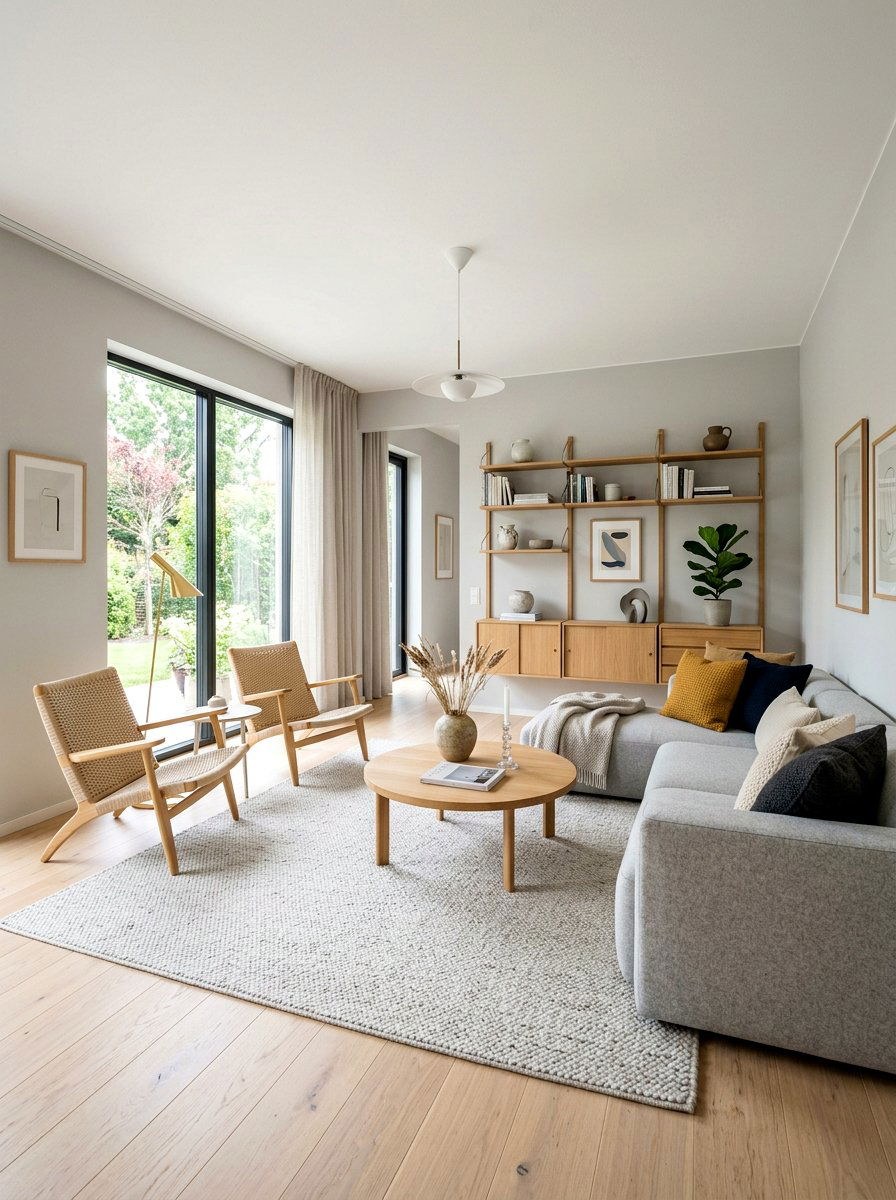
The formula: pale base, one wood tone, a sofa in a plain weave, exactly three textile layers (rug, throw, cushions), one plant, black only in thin lines — lamp stems, frame edges. If your sofa is dark, don’t panic and don’t buy a new one: a pale throw over the back and two cream cushions ($16 total) re-proportion the whole thing. Small spaces get the biggest lift here — leggy furniture and a light floor are half of why the small apartment living room formula works.
Bedroom
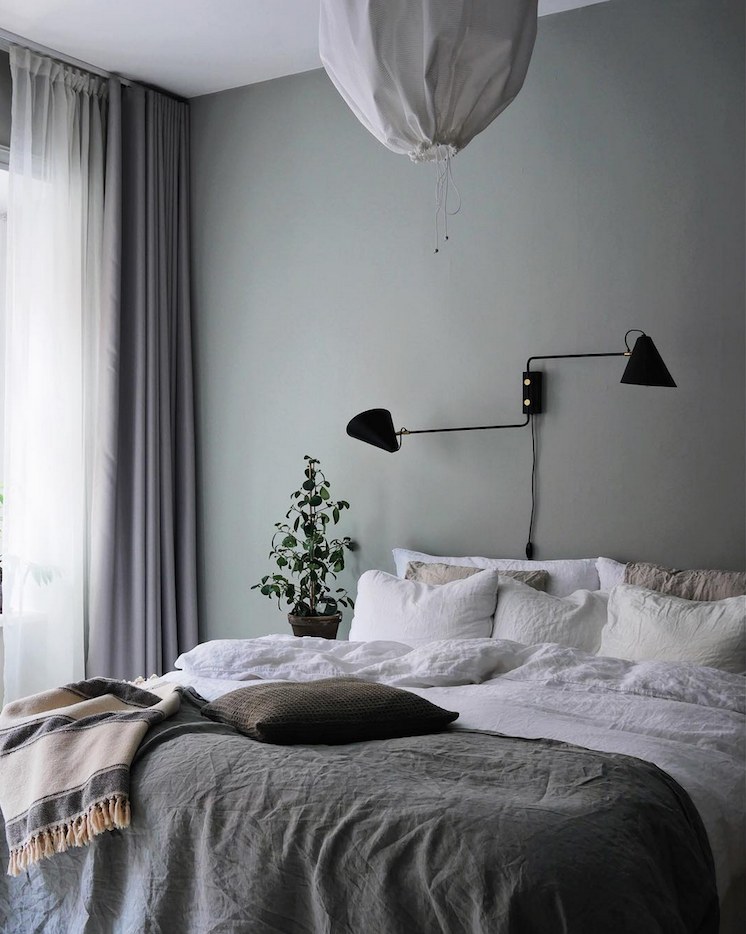
The cheapest room to convert, because bedding is the decor. White or stone-colored bedding ($24 for a cotton duvet set), one wool-look throw, wood or white nightstands, and black sconces or lamps for the thin-line contrast. Skip the cushion mountain — two sleeping pillows, two cushions, done. If you want the full neutral palette worked out shade by shade, our neutral bedroom decor ideas pair with this perfectly.
Kitchen and dining
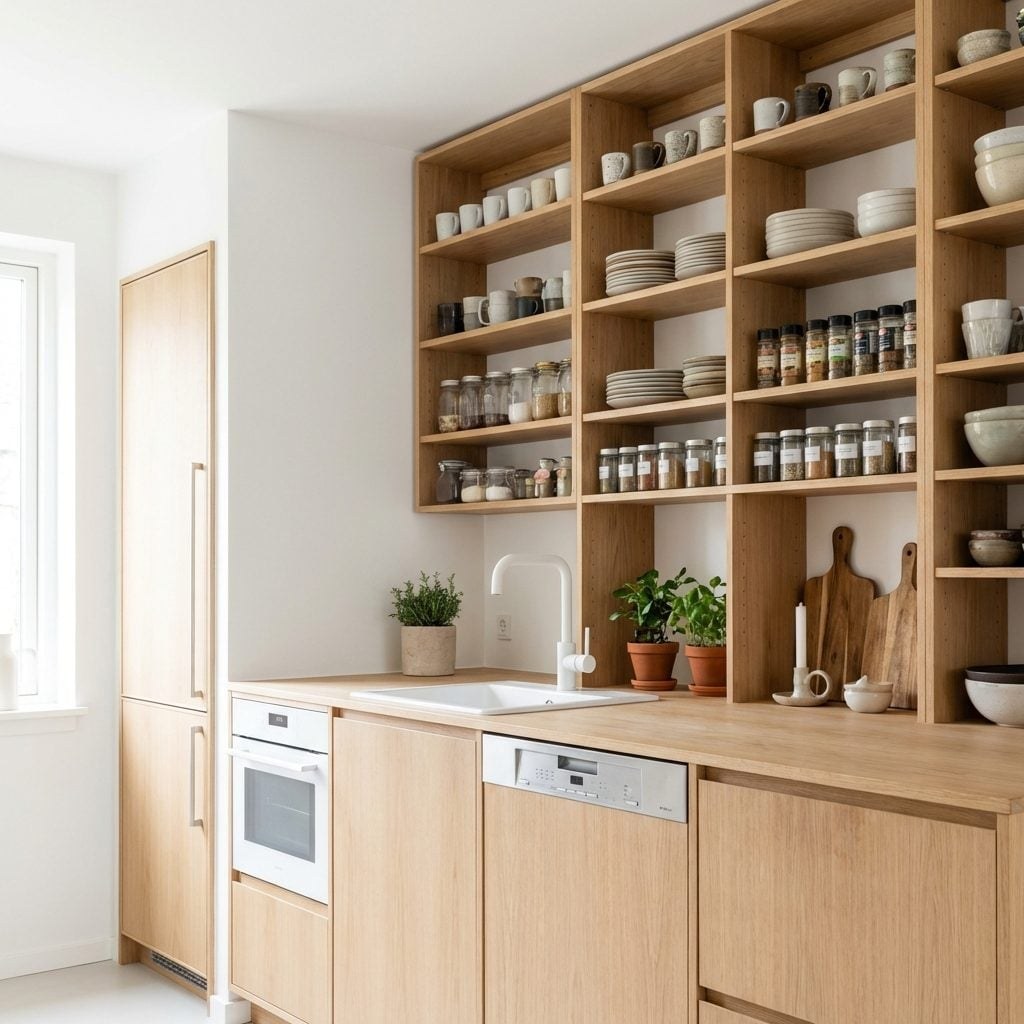
Decant everything into glass and wood, keep only white or wood on open shelves, and hang one pendant low over the table. The dining set is where thrift stores shine — spindle-back and bentwood chairs are everywhere for $8–20 each because this style has been common for 70 years. Mismatched? Paint them one color (see above) and they’re a set.
Entryway and bathroom (the fast wins)
Entryway: a pale runner, a row of wooden pegs ($9 for a peg rail), one mirror. Bathroom: white towels bought as a set ($16), a wood bath mat or stool, everything else hidden. Both rooms convert for under $30 each because they’re small — scandinavian home decor on a budget rewards small square footage everywhere it goes.
IKEA vs Thrift Store: An Honest Price Fight
Everyone assumes IKEA is the cheapest route to this look. Sometimes. Here’s the fight, item by item, at real 2026 prices:
| Item | IKEA (new) | Thrift / secondhand | Winner |
|---|---|---|---|
| Paper pendant shade | ≈ $10–15 (REGOLIT/KRUSA class) | Rare, $3 when found | IKEA — buy new, shades yellow with age |
| Pine dining table | ≈ $129–199 flat-pack | $25–60 solid vintage pine | Thrift — solid wood beats flat-pack and costs a third |
| Dining chairs (each) | ≈ $45–65 | $8–20 spindle/bentwood | Thrift, and it isn’t close |
| Cushion covers | ≈ $5–10 | $2–4 | Tie — IKEA wins on matching sets |
| Glass jars / storage | ≈ $2–5 each | $0.50–1 each | Thrift |
| Flatweave rug 5×7 | ≈ $59–99 | $15–40, condition varies | IKEA for bedrooms (hygiene), thrift for under-table |
| Sheepskin (faux) | ≈ $13–15 | Seldom found | IKEA |
The pattern: IKEA wins on soft, hygienic and fragile things. Thrift wins — hugely — on solid wood, because Scandinavia spent decades exporting exactly this furniture and half of it ended up in American thrift stores. This is why I call Scandi the easiest style in the world to thrift: the supply is endless and the lines are so simple that a $30 table and a $3,000 table read almost the same in a photo. (For the deep history of why the lines look like this, Scandinavian design is a genuinely good read.)
7 Mistakes That Make Budget Scandi Look Cheap Instead of Calm
Three years and two apartments of doing scandinavian home decor on a budget, and these are the failures I see on repeat — most of them in my own first attempts:
1. Blue-white paint. The single most common failure. If the chip looks even slightly blue in the store, it will look icy at home. Warm white or nothing.
2. Gray on gray on gray. Covered above, but it bears repeating — gray needs wood and cream against it, or it’s a waiting room.
3. Skipping texture to “keep it minimal.” Minimal isn’t bare. A pale room with zero wool, linen or jute doesn’t read calm; it reads unfinished. Three textiles minimum per room.
4. One big ceiling light. Scandi evenings are built from small warm pools of light. Three lamps at different heights, all 2700K — a $7 bulb swap fixes more rooms than a $70 decor haul.
5. Buying “Scandi-style” decor objects. Gnomes, reindeer, little wooden houses — tourist-shop Scandinavia. Real rooms use ordinary useful things: a good bowl, a plant, a stack of books.
6. Heavy curtains. Dark or thick drapes undo the entire point. Sheers, linen, or nothing. Privacy problems get a roller blind, not a light-blocker.
7. Clutter in pale colors. Painting everything white doesn’t declutter it. Lagom first, palette second — editing is step zero of scandinavian home decor on a budget, and it’s free.
What I’d Skip Entirely
Everything on this short list gets recommended for scandinavian home decor on a budget constantly — and every one of them is a waste of it. Save your money: the designer icons (a real Wishbone chair costs more than my whole plan ten times over, and the silhouette reads the same in a $15 thrifted bentwood). Bouclé everything — one cushion, maybe; a full bouclé room is a trend with an expiry date. New “distressed” furniture that fakes age at triple the price of actual old furniture. And matching furniture sets of any kind — nothing kills the collected, calm feeling faster than a showroom set.
Scandinavian Home Decor on a Budget: Your Questions
What is the cheapest way to start? Don’t buy anything for the first weekend. Edit (clear surfaces, group what’s left), swap in warm 2700K bulbs ($7), and wash or swap your heaviest textile for something pale. Most people get 60% of the effect for under $10.
Can I do scandinavian home decor on a budget in a rental? Yes — this is one of the most rental-friendly styles there is. The heavy lifting is textiles, rugs, lighting and editing, none of which touch the walls. If you can paint one wall warm white, great; if not, a pale rug and curtains carried close to the ceiling do most of the same work.
Is IKEA always the cheapest option? No. IKEA wins on textiles, shades and faux sheepskins. For solid wood — tables, chairs, sideboards — thrift stores beat it by half to two-thirds, and the vintage pieces are better built. My $50/$150 plans deliberately mix both.
What exact colors should I buy? Warm white walls, pale natural wood, oatmeal/cream textiles, and ONE muted accent — sage green and dusty blue are the most forgiving. Black appears only in thin lines: lamp stems, frames, chair legs. That’s the 70/25/5 ratio in shopping-list form.
My furniture is dark wood. Do I have to replace it? Almost never. Sand and oil the tops lighter, paint the worst offenders warm white, and drown the rest in pale textiles. One dark piece in a pale room actually works — it becomes the 5% grounding accent. Five dark pieces is a different problem, and paint is still the answer, at $14 a quart.
How much should one room cost, honestly? A bedroom converts for $35–60 (bedding does the work). A living room runs $50–150 depending on whether a rug enters the picture. Anyone quoting you $400+ for a “budget refresh” is selling, not helping.
The Calm Is Mostly Free
That’s the thing nobody selling furniture will tell you: scandinavian home decor on a budget works because the expensive version and the thrifted version are built from the same five habits, and four of them cost nothing. Lighten the palette, unify the wood, layer three textures, warm the light, and edit like a Swede. Spend the $50 where it shows — then stop, make tea, and enjoy the quiet.
Working through the rest of the house? The Budget Home Decor shelf has every room-by-room guide we’ve published, and the pillar economy home decor guide ties the whole approach together.