
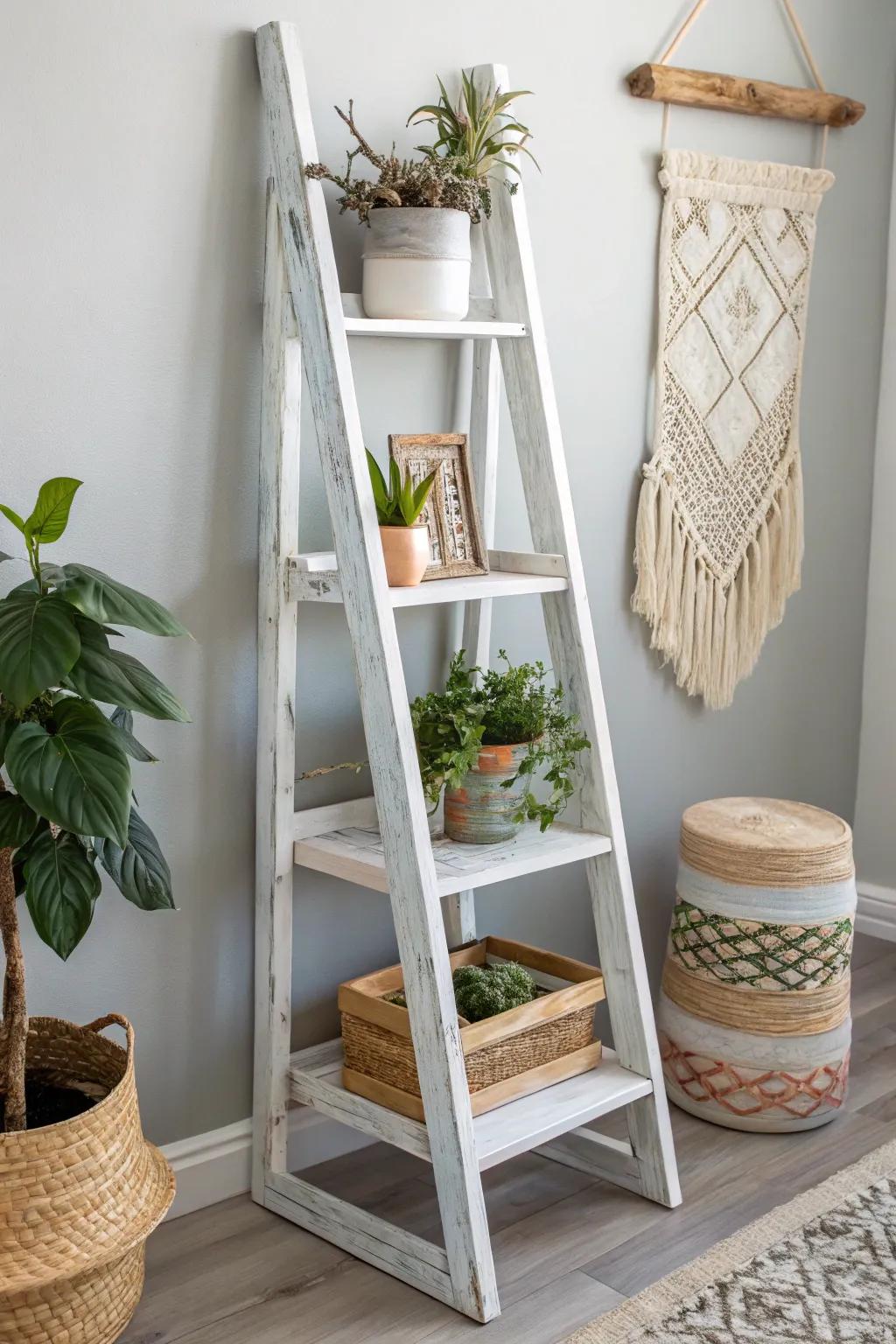
Last spring I dragged a wooden ladder home from a yard sale for $4. The seller apologized for the paint splatters. I sanded it for twenty minutes, leaned it against my living room wall, and it has held plants, baskets and a rotating stack of library books ever since. A similar ladder shelf at a furniture store runs about $120. That gap — between $4 plus sandpaper and $120 plus shipping — is exactly why I keep coming back to upcycled home decor ideas, and it’s also why I’m picky about them. Some projects genuinely beat buying new. Some quietly cost more than the new version once you buy the supplies. This list separates the two.
Below you’ll find 14 projects organized by the thing you’re starting with — a ladder, a door, a drawer, a pile of jars — each one priced honestly, supplies included, with the time and skill it actually takes. There’s also a sourcing playbook for getting the raw materials free, and a short list of things I never upcycle, because some castoffs should stay castoff.
The Honest Math Behind Upcycled Home Decor Ideas
Most upcycling content skips the receipts. A “free” pallet project that needs $30 of casters, sealant and sandpaper isn’t free, and a Saturday of your time isn’t free either. So here’s my rule: an upcycle only wins if the all-in cost — item plus every supply you’d have to buy — lands at half the price of a comparable new piece, or less. When it doesn’t, I’ll tell you to buy new and spend your weekend on something else.
| Project | Upcycle cost (all-in) | Comparable new price | Verdict |
|---|---|---|---|
| Ladder leaning shelf | ~$10 | $90–$180 | Beats new, easily |
| Crate wall shelves (set of 3) | ~$14 | $60–$90 | Beats new |
| Old door headboard | ~$32 | $150–$300 | Beats new, easily |
| Drawer under-bed storage | ~$11 | $25–$35 | Beats new, barely |
| Pallet coffee table | ~$24 | $120–$200 | Beats new |
| Mason jar sconces (pair) | ~$15 | $60–$80 | Beats new |
| Reupholstered accent chair | $60–$90 + ~6 hours | $99 on sale | Buy new |
That last row matters. Reupholstery is the project every blog romanticizes and almost nobody prices: foam, fabric and batting for one chair can hit $80 before you’ve pulled a single staple, and a basic new accent chair goes on sale for $99 a few times a year. Unless the chair itself is real hardwood with good bones, buy new and don’t feel guilty. The best upcycled home decor ideas are the boring-math ones — sturdy wooden things that need cleaning and imagination, not a supply run that eats the savings. It’s the same logic behind our economy home decor approach to the whole house: spend where it shows, save where it doesn’t.
Upcycled Home Decor Ideas, Sorted by What You’ve Got
Don’t shop for a project. Start with what’s already in your garage, your curb pile or the free listings, then match it to a project below. Every entry lists what it costs all-in, how long it takes, and how hard it honestly is.
Ladders: the $4 shelving unit
Leaning ladder shelf. Cost: $4–$10 (ladder plus sandpaper; add $6 for wall-anchor straps). Time: 45 minutes. Skill: beginner. A wooden ladder with flat rungs is a shelf the day you bring it home. Sand the splinters, wipe it down, lean it at a slight angle and anchor the top to a stud — that anchor is not optional if you have kids or cats. Style it like the photo up top: heavy baskets low, plants and books up high. Blanket ladder. Cost: $0–$3. Time: 20 minutes. Skill: beginner. Same ladder, even less work. It beats the $45–$70 stores charge for a decorative blanket ladder, and it keeps throws off the sofa arms.
Doors: headboards with actual presence
Five-panel door headboard. Cost: $15–$40 for the door (architectural salvage yards price them around $25), plus $7 of paint if you’re changing the color. Time: about 2 hours, mostly drying. Skill: beginner to intermediate — you need a saw or a helpful hardware store to trim it to width. Mount it to the wall studs, not the bed frame. A solid old door has more character than any flat-pack headboard I’ve seen under $300, and it’s heavy, real wood. Door corner shelf. Cost: $10–$20. Time: 2–3 hours. Skill: intermediate. A door cut lengthwise and rejoined at a right angle makes a tall corner shelf. It’s the one door project I’d call genuinely fiddly — worth it only if the door was free.
Crates: shelving that stacks any way you like
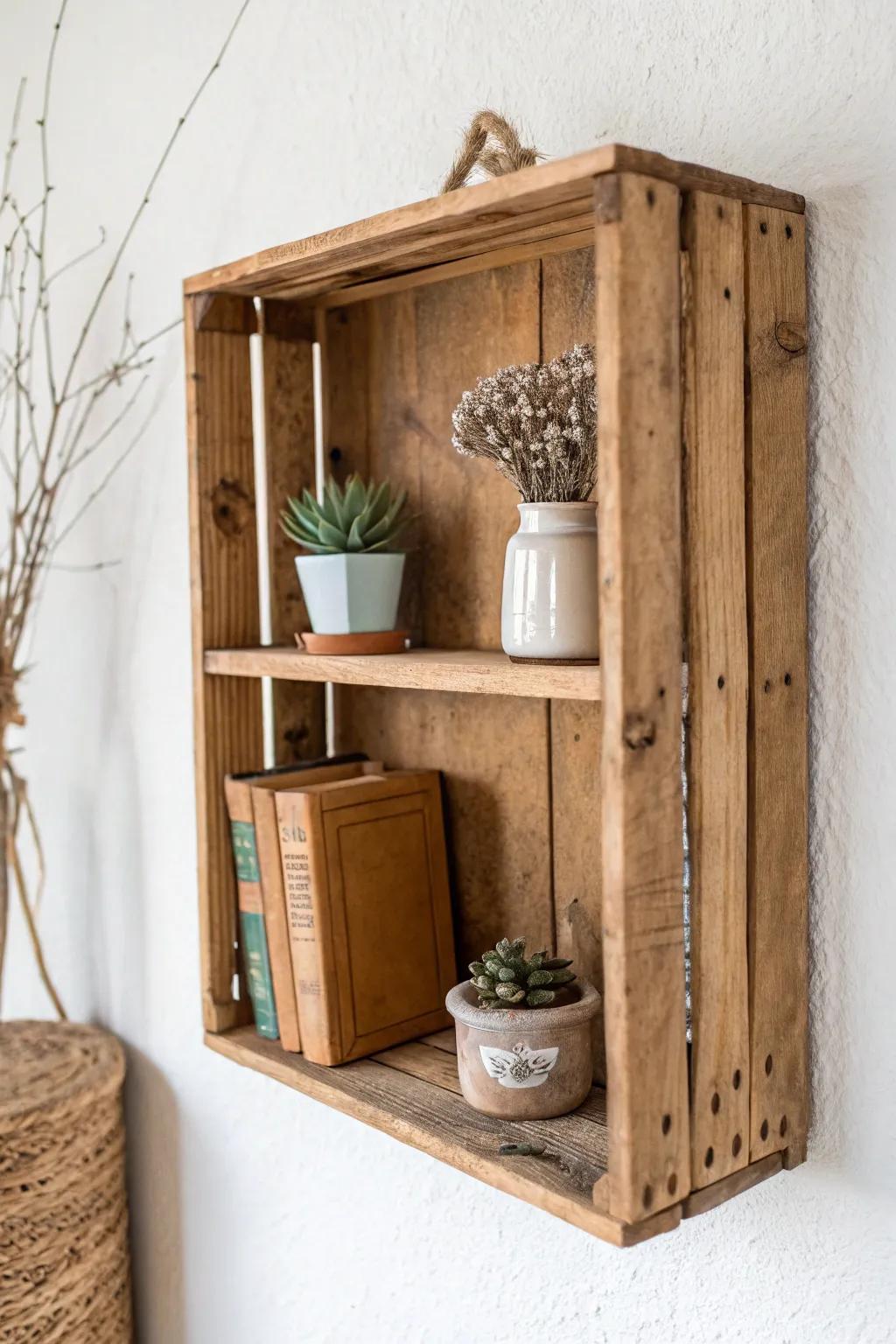
Crate wall shelves. Cost: $3–$8 per crate secondhand, sometimes free if you ask at liquor stores or orchards; $5 of screws and anchors for a set of three. Time: 1 hour. Skill: beginner. Sand, stain if you want, screw through the back slats into studs. Three crates hold what a $75 floating-shelf set holds, and you can rearrange them when you’re bored. This is the most farmhouse-friendly project on the list — it pairs with half the looks in our farmhouse decor on a budget guide. Crate side table. Cost: $8–$14 (two crates plus a cushion or a cut board top). Time: 40 minutes. Skill: beginner. Two crates stacked opening-out give you a table and storage in one footprint. Of all the upcycled home decor ideas in this list, the crate projects are the ones my friends actually copy — nobody writes back about the door headboard.
Drawers: the dresser died, the drawers live on
When a cheap dresser collapses — and they do, usually at the back panel — the drawers are almost always still solid. They might be the best raw material in this whole list.
Drawer wall shelf. Cost: $0–$5 (leftover paint, two brackets). Time: 1 hour. Skill: beginner. Pull the drawer, paint the inside a contrasting color or line it with leftover wallpaper, hang it by its frame. Drawer under-bed storage. Cost: $8–$11 for four small casters. Time: 30 minutes. Skill: beginner. Screw casters to the corners and a junk drawer becomes rolling storage that fits where $30 plastic bins are too tall. Drawer pet bed. Cost: $10 for a cushion or foam offcut. Time: 30 minutes. Skill: beginner. My cat has slept in hers for two years and ignores the $40 bed I bought before it. Drawers are also how I organize serving pieces for the table setups in our dining table decor guide — a shallow drawer is a perfect cutlery-and-napkin caddy.
Pallets: worth it, with one safety check
Pallet projects are the gateway drug of upcycled home decor ideas — free wood, endless photos online. They’re also the project where people skip the one check that matters.
Pallet coffee table. Cost: $0 for the pallet, $12 for casters, $8–$12 for sealant and sandpaper. Time: 2–3 hours, most of it sanding. Skill: intermediate. Two stacked pallets on casters make a rustic table that stores magazines in the slats. Non-negotiable: check the stamp on the side. You want “HT” (heat treated). If it says “MB” (methyl bromide) or has no stamp at all, walk away — that pallet is firewood, not furniture. More on that below.
Jars and bottles: the 20-minute wins
Mason jar sconces. Cost: $6–$9 per sconce for a hose clamp, a small board offcut and a hook; the jars you already own. Time: 20 minutes each. Skill: beginner. Clamp the jar to the board, add a battery tea light (never a real candle in a clamped jar you can’t reach easily), hang. Bottle vases. Cost: $0–$4. Time: 15 minutes. Skill: beginner. A wine bottle with the label soaked off and a $4 can of matte spray paint — shared across a dozen bottles — reads as a ceramic vase on a shelf. These two are the fastest upcycled home decor ideas I know, and they’re the ones guests ask about most.
Frames and fabric: the closet cleanout projects
Frame serving tray. Cost: $2 thrifted frame plus $4 of stick-on handles. Time: 30 minutes. Skill: beginner. Put fabric or scrapbook paper under the glass, add handles, done — a $28-looking tray for the coffee table. Sweater and denim pillows. Cost: $0 if you stuff them with old t-shirts, $5 for a cheap insert. Time: 45 minutes with basic sewing, or use fabric glue and call it rustic. Skill: beginner. A shrunken wool sweater makes a pillow cover with better texture than most $25 store covers. My rule for fabric projects: if you wouldn’t wear it against your skin anymore because it’s scratchy, it can still work as a pillow nobody leans on — but skip anything stained or musty. No amount of Febreze fixes musty.
Where to Find Free and Cheap Castoffs: The Sourcing Playbook
Good upcycled home decor ideas start with good raw material, and the raw material is out there for free if you know the rhythm of it. Here’s where I actually get mine:
- Facebook Marketplace “Free” section and curb alerts. Set alerts for “curb alert,” “free,” and the specific words “ladder,” “dresser,” “solid wood.” The good stuff goes within the hour, so alerts matter more than browsing. Buy Nothing groups are slower but friendlier, and neighbors will often hold a piece for you.
- Curbs on bulk-trash days. Every city posts a bulk pickup schedule; the evening before is prime time. End of the month is best — people moving out leave solid furniture because the truck is full. Drive the apartment-dense streets first.
- Estate sales on the last day. Day one is for collectors. The final afternoon, prices drop 50–75% and the remaining furniture — doors, ladders, crates, frames — is exactly our material, because upcyclers are the only ones left who want it.
- Habitat for Humanity ReStores and salvage yards. Doors, shutters, cabinets and hardware at a fraction of retail, and the stock turns over weekly. This is also where I check prices before paying anything on Marketplace — if ReStore sells doors for $25, nobody’s “vintage door, $90, firm” is a deal.
- Ask businesses. Liquor stores and farm stands give away or cheaply sell wooden crates; wine shops part with bottles; offices dumping furniture during a refit will happily let you haul a desk away free.
One discipline that keeps this cheap — honestly, it’s the golden rule of upcycled home decor ideas: the material chooses the project, not the other way around. I keep a running “wanted” list on my phone — currently a twin headboard and two matching drawers — and I don’t buy anything that isn’t on it or obviously better than what’s on it. Upcycling hoards start exactly where that list ends. And when you do buy secondhand brands instead of raw material, our sustainable home decor brands guide covers the new-but-responsible side of the same coin.
What I Never Upcycle (and You Shouldn’t Either)
This is the section the pretty listicles skip, and it’s the one that matters most:
- MB-stamped or unstamped pallets. “MB” means fumigated with methyl bromide. No stamp means unknown chemical history. HT (heat treated) only, ever.
- Anything with peeling pre-1978 paint, unless you test it. Old doors and dressers are exactly where lead paint lives. A $10 test kit settles it; if it’s positive, don’t sand it in your kitchen — the EPA’s lead guidance explains why the dust is the dangerous part.
- Moldy or smoke-soaked upholstery. Foam holds smells and spores permanently. Wood frames can be cleaned; cushions can’t. Pass.
- Old cribs and car seats. Safety standards changed for good reasons. A crib becomes a bench or a trellis, never a crib again.
- CFL bulbs and old wiring. Compact fluorescents contain mercury — recycle them, don’t craft with them. And leave lamp rewiring to people who enjoy electrical work; a $9 new socket kit installed wrong is not a bargain.
- Anything pressure-treated or creosote-smelling — old railroad ties, green-tinted deck boards — for indoor use. Outdoor planters, maybe. Your living room, no.
Mistakes That Make Upcycled Home Decor Ideas Look Cheap
Good bones, bad execution — I’ve made every one of these:
- Distressing everything. Sanded edges on the ladder AND the crates AND the door reads “craft fair,” not collected. Pick one distressed piece per room; keep the rest clean-finished.
- Skipping the cleaning step. Paint over grease or nicotine and it will bleed through within a month. Degreaser and a rinse first, always. Most failed upcycled home decor ideas actually failed at the sink, not the sander.
- Buying supplies at full retail. New casters, new handles and a new quart of paint can double a project’s cost. Hardware is the one thing thrift stores and ReStores sell for pennies — buy it there.
- No anchor, no level. A leaning shelf that isn’t strapped to the wall and a wall shelf hung by eye are how upcycles end up on the floor. Ten minutes with a level and a stud finder.
- Keeping the “before” hardware. Rusty hinges and dated pulls give the game away. Swapping hardware is the cheapest five minutes in any project here.
Upcycled Home Decor Ideas: Questions, Answered
What is the cheapest upcycled decor project to start with?
The bottle vase or the drawer shelf — both can cost literally $0 if you own paint, and both take under an hour. Start there. Early wins teach you the sanding, cleaning and styling basics before you commit a weekend to a door headboard.
Is upcycling actually cheaper than buying new?
Sometimes — and that’s the honest answer. The upcycled home decor ideas that save real money win big on solid wood furniture, shelving and headboards, where new prices are high and the upcycle is mostly cleaning and paint. It loses on reupholstery, anything needing lots of small hardware, and projects where you’d buy tools for one use. Run the all-in math, including supplies, before you start. If the upcycle lands under half the new price, go. If not, buy new without guilt.
Where do people find free furniture to upcycle?
Facebook Marketplace’s free section, Buy Nothing groups, curbs the night before bulk-trash pickup, and the last day of estate sales. Set keyword alerts — the good pieces go fast. Apartment-heavy streets at the end of the month are the single most reliable source I know.
How do I make upcycled decor not look like a craft project?
Three things: one consistent finish (the same paint color or stain across pieces makes mismatched finds look like a collection), restraint (one upcycled statement piece per room beats five), and mixing with a couple of clean, modern basics. The craft-project look usually comes from too many distressed, cutesy pieces in one space, not from any single piece.
What paint works on old varnished wood and laminate?
On varnished wood: clean, scuff-sand with 120-grit, use a bonding primer, then your paint. On laminate: the same bonding primer is the whole secret — skip it and the paint will peel in sheets. Chalk paint skips the primer on wood (not laminate) but needs a wax or poly topcoat anywhere it’ll get touched daily.
Is pallet wood safe to use indoors?
Only heat-treated pallets stamped “HT.” Check the stamp on the side stringer before you load it. Avoid “MB” stamps and unstamped pallets, wash and sand thoroughly, and seal the finished piece. If you can’t find the stamp, don’t bring it inside — there are always more pallets.
The short version of everything above: upcycled home decor ideas work when the math works — a sturdy castoff, cheap supplies, and an honest comparison against the new price. Start with the $0 projects, build the sourcing habit, skip the chemical mysteries, and your house will fill up with pieces that have a story and a receipt you can brag about. This whole cluster of projects sits inside the Budget Home Decor corner of the site, if you want to keep going down the cheap-and-good road.