
My first real home office cost $112 and measured exactly 40 inches wide. It was a thrifted desk wedged between my bed and the wall, a $15 lamp, and a chair I dragged in from the dining table every morning and dragged back every night. It was ugly. It also worked — because small home office ideas on a budget aren’t really about decor. They’re about three numbers: how wide the desk is, how deep it is, and how much floor the chair needs. Get those right and almost any nook turns into an office.
Below are the five layouts I recommend, each with its real footprint and an itemized price, plus the $50, $150 and $300 tiers if you’d rather shop by budget than by room. This is the same measure-first, decorate-second discipline behind our economy home decor guide — it just happens to have a keyboard in it now.
Small Home Office Ideas on a Budget Start With Three Measurements
Before you look at a single desk, measure your nook and write down three numbers.
Desk width: 40 inches is the floor, 48 is the sweet spot. A 40-inch desk fits a laptop, a notebook and a mug — nothing else. A 48-inch desk fits a laptop plus a monitor, or a monitor plus actual elbow room. Below 40 inches you’ll hate it within a week; above 55 inches it stops being a “nook” desk and starts eating the room.
Desk depth: 20–24 inches. Your screen should sit roughly an arm’s length away — about 20–28 inches from your eyes. On a 20-inch-deep desk with a laptop that’s automatic. Go deeper than 24 inches in a small room and you’re just donating floor space to a surface that collects paper.
Chair clearance: 36 inches from the desk edge. That’s desk depth plus room to push back and stand up without doing a sideways shuffle. In a closet office the chair lives in the room, not the closet, so measure from the closet opening. Every layout below is built on these three numbers — they’re what separate small home office ideas on a budget that work from the ones that just photograph well.
Layout 1: The Closet Office (Cloffice) — About $75
A standard reach-in closet is 4 to 6 feet wide and 24 inches deep. That depth number is the whole game: a 24-inch-deep closet takes a full-depth desk surface, which most people don’t realize until they measure. Pull the hanging rod, keep the shelf.
The build: a laminate shelf board or a cut-to-fit pine slab spanning the width (48–72 inches, $18–$25 at a home center, and they’ll cut it free), resting on two ledger strips screwed into the side walls ($8 for lumber and screws). Two floating shelves above, $10 each or thrifted. An LED strip under the top shelf, $9, because closets have no light and you’ll feel like you’re working in a cave without one. Chair: whatever you already own, or a $25–$40 thrifted task chair. Total: about $75, and the doors still close at night, which means the office literally disappears. Of all the small home office ideas on a budget in this guide, this is the one I’d build first in a small apartment.
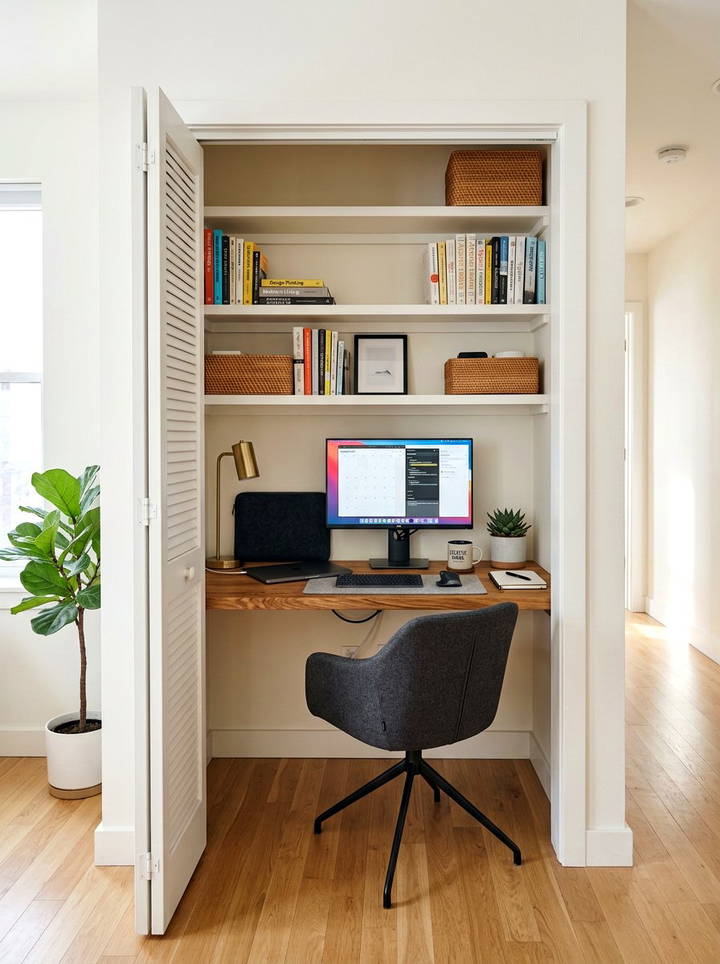
One honest warning: no window means no airflow either. A small USB fan ($10) on the shelf isn’t optional in summer.
Layout 2: The Bedroom Corner — About $150
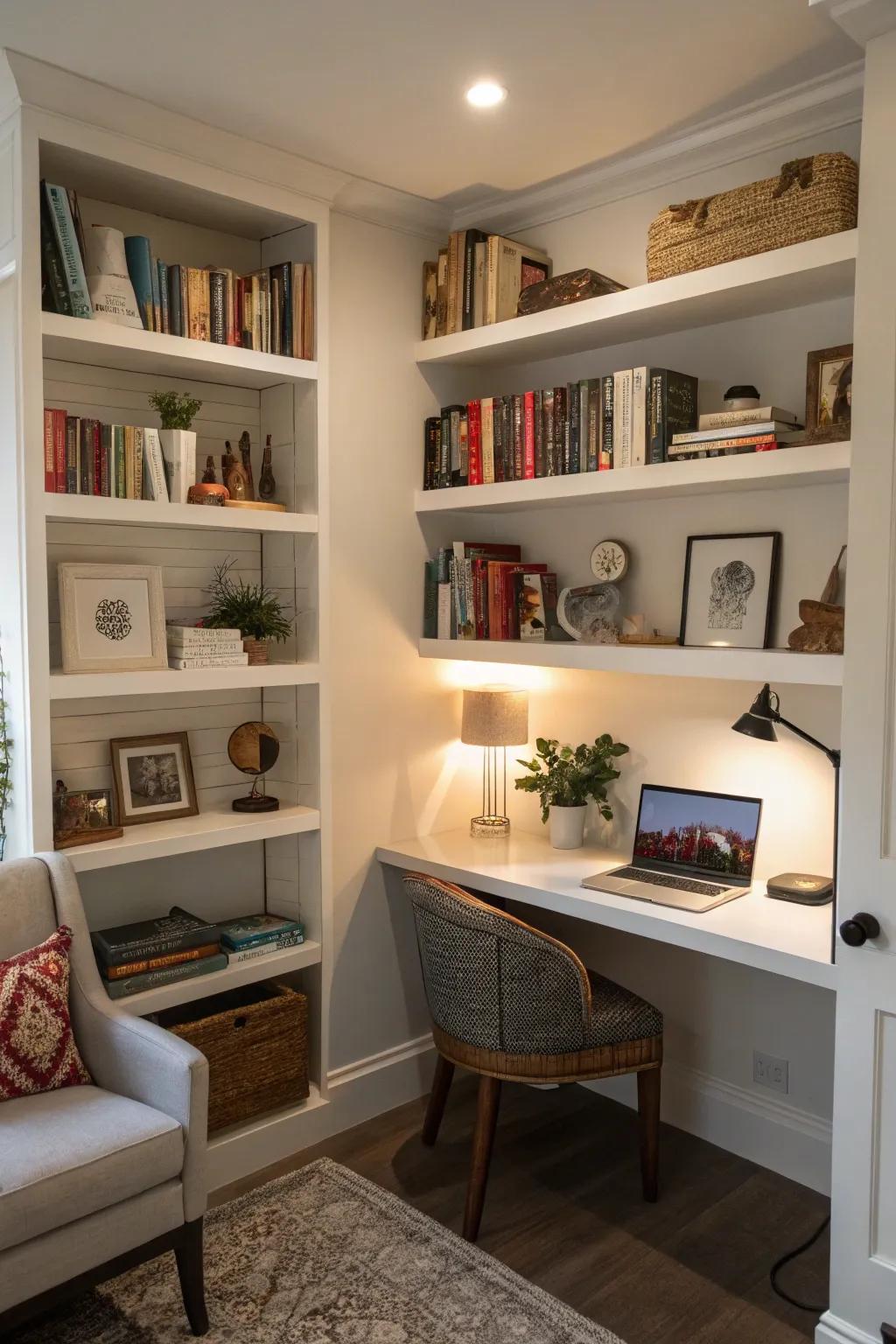
A corner gives you two walls, and two walls give you free storage: shelves on one side, a pegboard or pinboard on the other, zero extra floor space used. The footprint is 4×4 feet — a 48-inch desk against one wall, chair clearance on the other axis.
The build: a simple 48-inch writing desk (the steel-frame SHW Mission style runs about $90 new; flat-pack equivalents are $60–$110 everywhere), a used task chair at $35, a clamp lamp at $15 so it doesn’t eat desk surface, and one 36-inch floating shelf at $12. Total: about $150. Face the desk into the room rather than into the wall if the corner allows it — staring at drywall eight hours a day is the part nobody warns you about.
It’s one of the most forgiving small home office ideas on a budget, because the corner does half the decorating for you.
Keep the bed made and the laundry basket out of the corner’s sightline. A bedroom office fails on morale, not measurements, and it fails fastest when the “office” looks at an unmade bed all day.
Layout 3: The Living-Room Slice — About $130
No spare corner, no closet? Take a 5-foot slice of living room and zone it. A 4×6 rug under the desk ($30–$40 thrifted or on sale) is the entire trick — it tells your brain, and everyone else in the house, where the office is. This is exactly the zoning logic from our small apartment living room guide, shrunk to desk scale.
Of all the small home office ideas on a budget in this guide, this is the renter favorite — nothing attaches to a wall.
The build: a 40-inch desk ($60–$75), a low bookcase turned perpendicular as a divider ($25 thrifted) which doubles as your storage and your “wall,” the rug, and a $12 lamp. Total: about $130. Sit with your back to the room’s traffic flow if you can — people walking behind your screen all day is a low-grade distraction you can’t un-notice.
Layout 4: The Under-Stairs Nook — About $105
The space under a staircase is dead square footage with a sloped ceiling, and it fits an office better than it fits anything else. The math: you need about 5 feet of headroom where your head actually is when seated — roughly 30 inches from the desk’s front edge. Deeper under the slope is storage country: file boxes, the printer, the spare monitor box you can’t throw away.
The build: a 40-inch desk ($65), chair $20 thrifted, and light — this is the darkest nook in any house, so budget $12 for two rechargeable LED puck lights or a plug-in bar light before you buy anything cute. Total: about $105. Small home office ideas on a budget don’t get much cheaper per square foot than a space that was storing empty suitcases.
Layout 5: Two People, One Room — About $290 Total
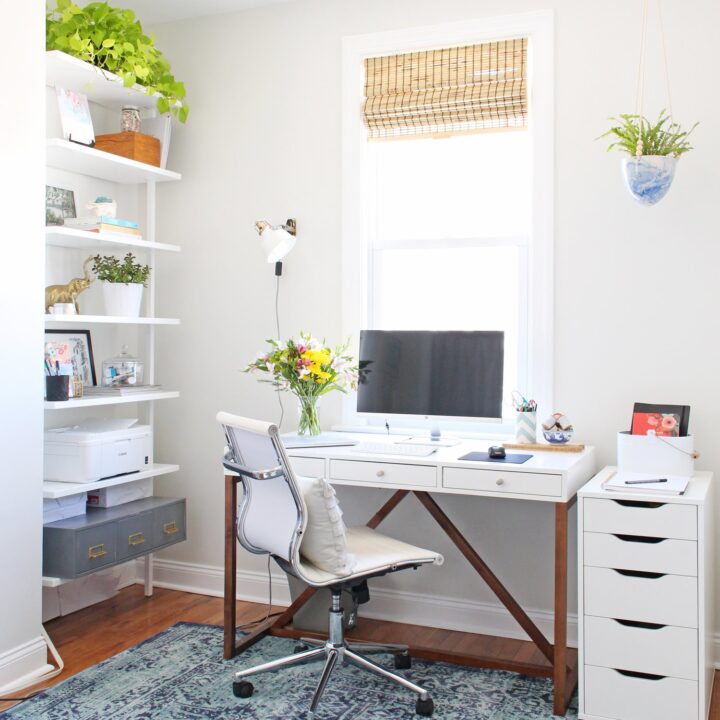
Two remote workers, one spare room (or one big corner) is the layout the persona searches keep asking about — “for 2 people” is a real variant, and most guides dodge it. Two ways to do it:
Side by side: two 48-inch desks along one wall = 96 inches of wall, one shared 48-inch shelf above both, two lamps. Cheapest and friendliest, but you’ll hear every call the other person takes.
Back to back: desks facing opposite walls, chairs back to back in the middle. You each get a wall, a background, and some acoustic dignity. Needs a room about 9 feet wide once chair clearance is counted.
Whichever version you pick, small home office ideas on a budget for two people come down to one rule: buy two of the cheap things, not one expensive thing to share.
The build (either version): two basic desks at $90 each, two used chairs at $35 each, one shared shelf $15, two clamp lamps $25 total. That’s about $290 for two complete workstations — $145 a person, less than one “ergonomic” chair bought new. Add $10 for a set of acoustic-ish soft stuff you already own: a rug and curtains absorb more call echo than any gadget under $50. For couples, that echo fix is the single best money in this whole section.
Small Home Office Ideas on a Budget: The $50, $150 and $300 Tiers
Shopping by room is one way. Shopping by wallet is the other. Here’s what each tier actually buys, using the layouts above as the parts list:
| Tier | What you get | The build |
|---|---|---|
| $50 | A real desk setup from zero | Thrifted desk $20 · thrifted chair $15 · lamp $6 · cable ties + clips $5 · one plant $4 |
| $150 | New desk, everything sorted | 48-inch desk $90 new · used task chair $35 · clamp lamp $12 · laptop riser or shelf $13 |
| $300 | The “I live here now” setup | Desk $95 · used ergonomic chair $110 · used 24-inch monitor $60 · lamp $15 · cable tray $12 · lumbar cushion $8 |
My honest take: if you work from home five days a week, the $150 tier is the floor, not the ceiling — and the $300 tier’s chair is where the money should go first. A $110 used ergonomic chair (the office-liquidation kind, Steelcase and Herman Miller cast-offs) beats a $110 new chair every single time. Small home office ideas on a budget live or die on that one purchase.
Make It Look Good on Zoom for About $20
Your background is the only part of your office most people will ever see. Three fixes, in order:
Good small home office ideas on a budget always design for the camera view, not just the chair view.
Camera at eye level. Laptop on a $13 riser or a stack of books that lives there permanently — not books you keep stealing back. Looking down at a laptop camera is unflattering to every human alive.
Light in front of you, never behind. Face a window if you can; if not, put your desk lamp behind the screen pointing at your face, ideally a bulb in the 4000K range — our lighting fixtures guide covers which bulbs flatter skin and which ones make you look like a witness-protection interview.
A background with exactly three things. One shelf or picture ledge, one plant, one framed print — arranged in a loose triangle 4–6 feet behind you. More than that reads as clutter on camera; less reads as a hostage video. A $6 thrifted frame with a free printable in it genuinely counts as the print.
Ergonomics and Cables: The Unglamorous $25 That Matters Most
A cheap office that wrecks your neck isn’t cheap. The numbers that matter, straight from OSHA’s computer workstation guidance: top of the screen at or just below eye level, screen about an arm’s length away (20–40 inches), elbows bent at roughly 90 degrees with forearms parallel to the floor, feet flat — on the floor or on a footrest, which for most of us is a $0 stack of books or a shoebox. Standard desk height is 28–30 inches; if your desk sits higher than your elbows when seated, your shoulders are shrugging all day whether you notice or not.
The best small home office ideas on a budget spend this $25 before a single dollar goes on decor.
Then cables. The full fix costs about $25 and takes twenty minutes: a cable tray under the desk ($12–$16) that swallows the power strip, velcro ties ($6) instead of zip ties you’ll have to cut, and one adhesive clip at the desk’s back edge for the charger you unplug daily. Route everything down one desk leg. That single vertical run is why some desks look calm and others look like a nest — it’s not the gear, it’s the one straight line.
No Window? Her Desk, His Desk? Quick Persona Fixes
No window: you don’t have a view problem, you have a light problem. A daylight bulb (5000K) in the main lamp, a $10 LED light bar over the desk, and a light-colored desk mat to bounce it around. Add a mirror on the wall opposite any borrowed light source. Windowless cloffices in particular need this — skip it and the space feels like a storage unit with Wi-Fi.
For her / for him: honestly the setups are identical; the styling layer is what changes. A warmer palette — wood tones, a woven basket for chargers, one soft textile — reads calm on camera. A darker palette — matte black desk accessories, metal and leather-look pieces — reads sharp and hides cable chaos better. Pick the layer that matches the room the office lives in, not a gender rule. Both cost the same $15–$25 in accessories.
7 Mistakes That Make a Small Office Fail
1. The dining chair, all day. Fine for a week. By week three your back files a formal complaint. Any used task chair with lumbar support beats the prettiest dining chair ever made.
2. A desk deeper than the nook. A 30-inch-deep desk in a 24-inch closet or a shallow corner means the chair has nowhere to go. Measure depth first — it’s the mistake I see most.
3. Buying storage before the desk fits. Shelves and organizers are the fun part, so people buy them first. Fit the desk and chair, live in it a week, then buy storage for the things that actually pile up — that’s the order small home office ideas on a budget actually work in.
4. Ignoring the door swing. A desk that blocks a closet or room door by two inches will annoy you four times a day, forever. Open and close every door near the nook before you commit.
5. The monitor on books, permanently. As a one-week test, great. As a lifestyle, it’s a neck ache with extra steps. A $13 riser or a $20 monitor arm ends it.
6. Cords across the walkway. One trip — yours or a guest’s — and the laptop learns to fly. Route along walls and down desk legs only.
7. Spending the whole budget on looks. The plant, the print, the cute organizer — after the chair, the light and the desk fit are right. Decor is the last 10%, and these small home office ideas on a budget are sequenced that way on purpose.
Frequently Asked Questions
What is the cheapest way to set up a small home office?
A thrifted desk ($20) and chair ($15), a $6 lamp, and $5 of cable ties — about $50 all-in if you already own the laptop. The closet-office version costs a little more (~$75) because you buy the shelf board and lighting, but it needs no desk at all and disappears behind doors. That’s why the cheapest small home office ideas on a budget almost always start at the thrift store, not the furniture store.
How much space do you actually need for a home office?
A 4×4-foot corner is the comfortable minimum: a 48-inch desk plus 36 inches of chair clearance. A closet office needs even less floor — a reach-in closet 4–6 feet wide and 24 inches deep, with the chair parked in the room. Under-stairs nooks work if you have about 5 feet of headroom where your head sits.
What desk size is best for a small home office?
48 inches wide by 24 inches deep is the sweet spot — it fits a monitor and a laptop (or a laptop and paperwork) without eating the room. Go 40 inches wide if the nook forces it, and don’t go below 20 inches of depth or your screen ends up too close to your face.
How do I make a small home office look good on video calls?
Raise the camera to eye level, put light in front of your face (window or a lamp behind the screen), and style the wall behind you with exactly three things: a shelf, a plant, one framed print, 4–6 feet behind your chair. That trio costs about $20 total with thrifted pieces.
Can two people share one small home office?
Yes — two 48-inch desks side by side need 96 inches of wall, or place them back to back in a room about 9 feet wide. Budget roughly $290 for both setups using used chairs. The thing couples actually fight about is call echo, and a rug plus curtains fixes most of it for free.
What if I have no spare corner at all?
Use a wall-mounted folding desk (about $45–$70) in a hallway or at the foot of a bed: it folds flat to 4–5 inches deep when you’re done. Pair it with a chair that already lives in the room. It’s the smallest-footprint version of every idea in this guide.
Start With the Tape Measure
Every good small office I’ve seen started with three measurements and a thrift run — not a mood board. Measure your nook, pick the layout that matches it, and spend the first dollars on the desk fit, the chair and the light. The styling is the cheap part, and it’s more fun once the bones work.
That’s the pattern behind all the small home office ideas on a budget in this guide: measure, fit, then decorate.
Browse the full Budget Home Decor collection for the rooms around your new office — a workspace this small borrows half its look from whatever it’s tucked into.