
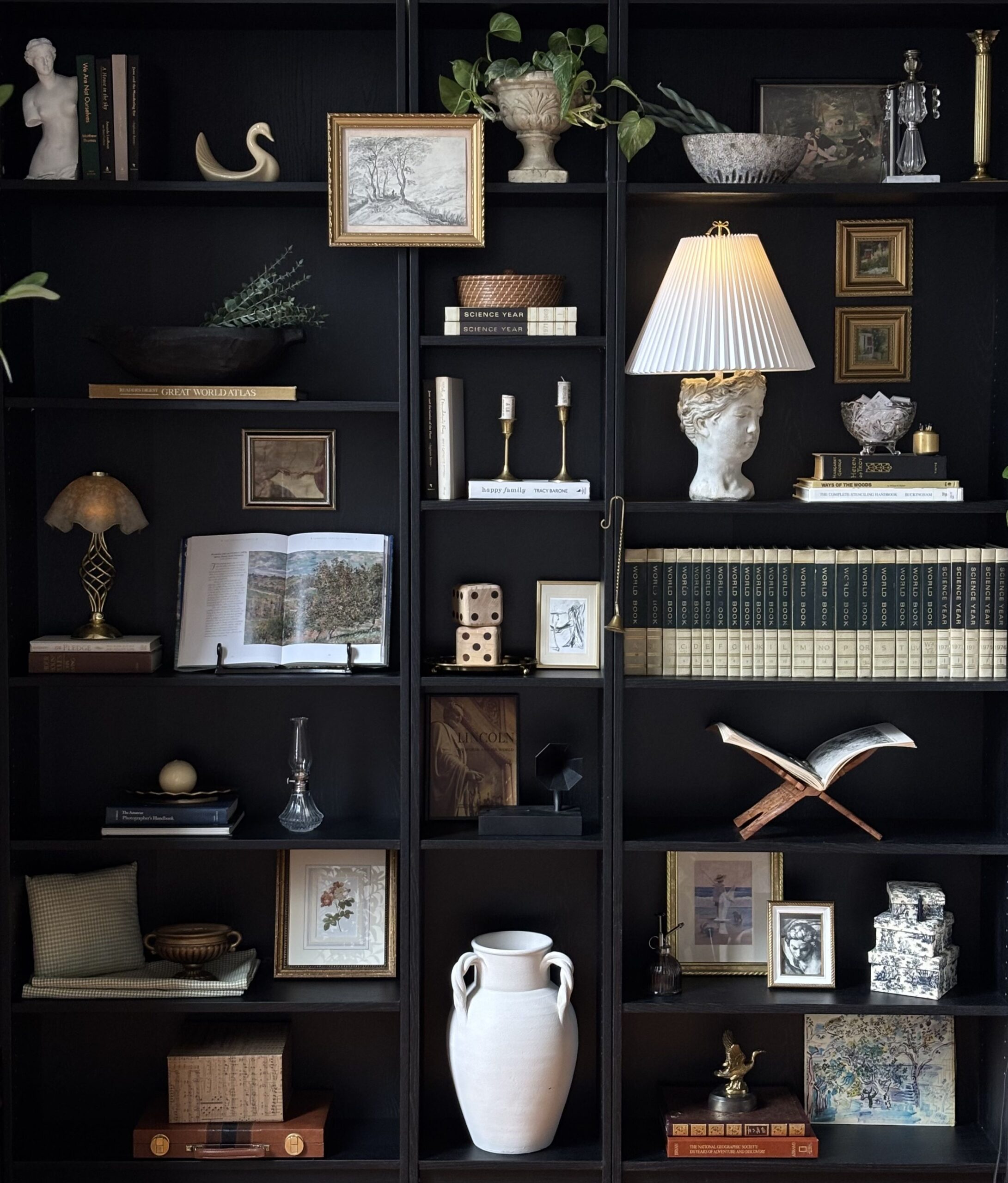
My living room bookcase used to look like a yard sale that had given up. Books crammed spine-to-spine, a sad candle, one photo frame face-down. Then I spent $6 at a thrift store — two brass candlesticks and a chipped ceramic swan — and restyled the whole thing in twenty minutes. Nothing about my taste changed. What changed is that I stopped guessing and started using formulas. The shelf styling ideas below are the exact ones I use now: three copy-exact formulas with real measurements, a playbook for each shelf type, and a per-shelf budget that tops out around $15.
Here’s the part nobody tells you: learning how to style a shelf has almost nothing to do with buying beautiful things. It’s spacing, heights, and restraint. A $1.25 candle in the right spot beats a $40 vase in the wrong one, every time.
Shelf Styling Ideas Start With the $0 Pass: Shop Your House First
Most shelf styling ideas you see on Pinterest start with a shopping list. Mine starts with a laundry basket. Before you spend a cent, do the free pass. I learned this the expensive way, buying decor for a shelf and then finding better candidates already sitting in my own cupboards.
Pull everything off the shelf. All of it. Wipe the shelf down (dust shows up in photos and in person more than you think), then walk your house with a laundry basket and gather candidates: hardcover books, one or two framed photos, a bowl, a basket, a small plant, candlesticks, a vase, that weird little box you like. This is the same shop-your-house-first discipline we use across our economy home decor guide, and shelves are where it pays off most, because a shelf only needs five to nine objects. Most homes already own nine decent objects. They’re just scattered.
Sort your basket into three piles: tall things (10 inches or more), medium things (5–9 inches), and small things (under 5 inches). That’s your inventory. Every formula below is just a way of arranging these three piles.
The 3 Formulas Behind Shelf Styling Ideas That Actually Work
Blogs love to say “play with heights and textures” and leave you there. Useless. These three formulas are the backbone of every shelf styling idea that actually works in a real house — here they are with the actual numbers, so you can copy them shelf for shelf. If you want a second opinion on the basics, The DIY Playbook’s shelf styling tips cover the same principles from a designer’s angle — but they don’t give you measurements. We will.
Formula 1: The Height Triangle
Every styled shelf has one tall anchor, one medium piece, and one small piece forming a triangle. The measurements that make it work:
- The tallest item should be 60–75% of the shelf opening’s height. For a standard 12-inch bookcase opening, that’s a 7–9 inch vase, plant, or leaning frame. Too short and the shelf looks empty; too tall and it looks crammed.
- Each level of the triangle should differ by at least 3 inches. A 9-inch vase, a 6-inch stack of books, and a 3–4 inch bowl reads as deliberate. A 9, a 7½, and a 6 reads as clutter, because your eye can’t separate them.
- Copy-exact example (12-inch opening): 9-inch vase left, stack of 2 books (about 3 inches) with a 3-inch candle on top center-right, 4-inch bowl front-right. Done. That’s a styled shelf.
Formula 2: The Rule of Thirds, With Real Gaps
Mentally split the shelf into three equal zones. Put groups in two zones and leave the third mostly empty. On a 36-inch shelf, that means roughly 24 inches of “stuff” and 12 inches of breathing room — and yes, that empty third is doing a job. It’s what separates styled from storage.
Between groups, leave 2–3 inches of clear space. Tighter than 2 inches and groups melt into one blob; wider than about 4 inches and they stop looking related. Of all the shelf styling ideas in this article, this is the one that fixes shelves fastest. Across the whole shelf, aim for around 30% empty space. When I think a shelf looks “almost right but off,” it’s nearly always this formula — I measure, find the gaps are 1 inch, spread things out, and it fixes itself.
Formula 3: Odd Numbers and the 60/30/10 Mix
Group in threes and fives. Three objects of different heights (there’s your triangle again), or one hero object plus a pair. Even-numbered groups look like they’re waiting for a partner; odd groups look finished. It’s the oldest trick in styling because it works.
Then check the mix: roughly 60% useful (books, baskets, storage with lids), 30% pure decor (vases, objects, candles), 10% personal (one photo, one souvenir, one weird thing you love). Shelves that are 100% decor look like a shop display. Shelves that are 100% storage look like a garage. The 10% personal is the part people actually comment on — my $2 thrifted swan gets more compliments than everything else on the shelf combined.
When people ask me where to start with shelf styling ideas, this is the unglamorous answer: the mix matters more than the objects. One more rule that ties it together: repeat one color or material three times across the whole unit. Brass candlestick on shelf one, brass frame on shelf three, brass bowl on shelf four. Repetition is what makes random thrift finds look like a collection.
Shelf Styling Ideas by Shelf Type: 4 Playbooks You Can Copy
The formulas are universal, but each shelf type has its own failure mode. The shelf styling ideas for each type below assume you’ve done the $0 pass first. Here’s how to style a shelf of each kind without falling into it.
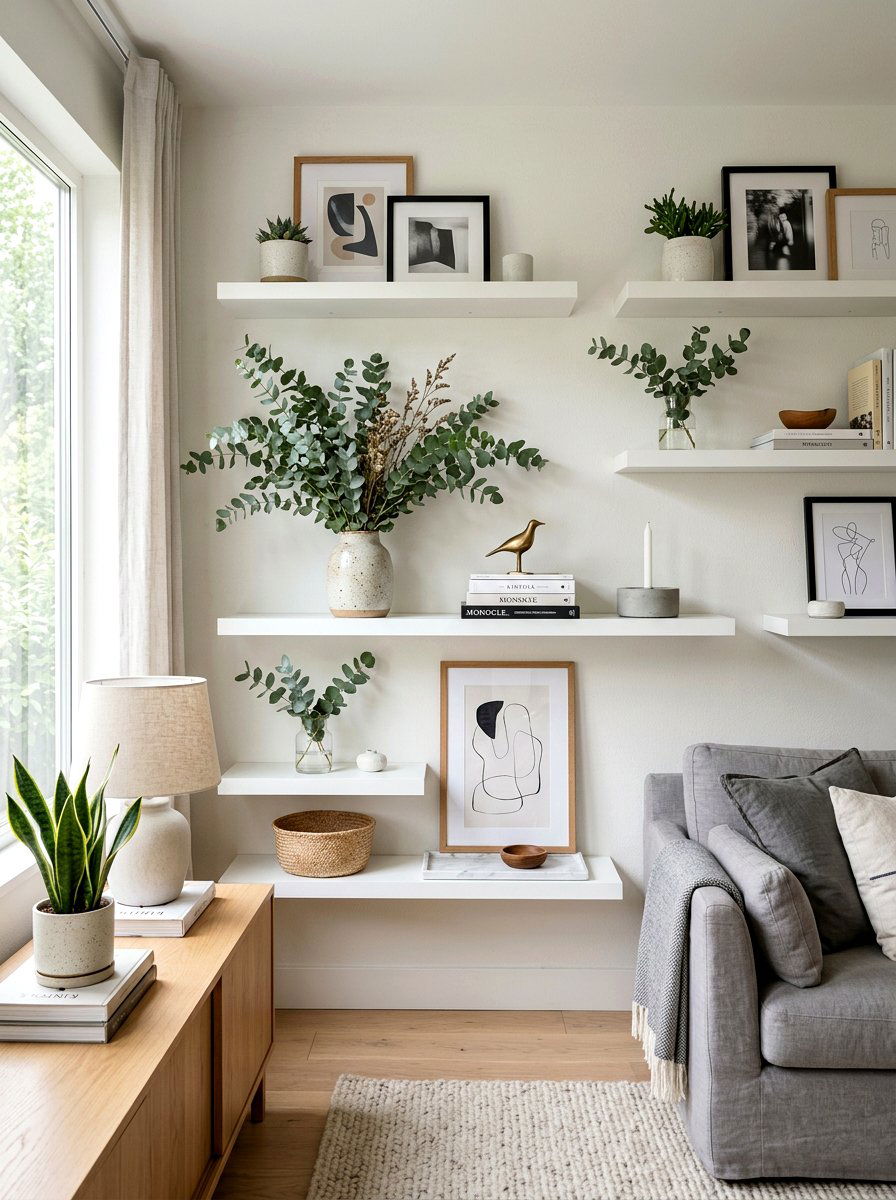
Floating Shelves: One Hero Per Shelf
Most shelf styling ideas for floating shelves fail when people treat them like bookcase shelves and load five groups onto each one. A floating shelf has no frame, so it needs less: one hero group per shelf, two at most on a 36-inch shelf. Alternate which side the group sits on as you go down — left, right, left — so the wall zigzags instead of stacking in a column. Keep the visually heaviest shelf at the bottom. And mind the real weight limit: most floating shelves are rated around 20–30 pounds, so the full book row belongs on the bookcase, not here.
Bookcase Shelves: The Zigzag Rule
For a bookcase, style the unit, not each shelf. Place your tallest anchor top-left on one shelf, then the next shelf’s anchor bottom-right of it, and keep zigzagging down. Book rows work best in runs of 8–14 inches, broken up by an object or a horizontal stack. A horizontal stack is 2–3 books, about 2–3½ inches tall total, with one small object on top — it’s a pedestal and a rest stop for the eye at the same time. Leave one shelf noticeably emptier than the rest. I know it feels wrong. Do it anyway. This zigzag is one of those shelf styling ideas that sounds fussy for exactly one shelf — then you step back and the whole unit suddenly looks deliberate.
Kitchen Open Shelves: Everyday Items Only
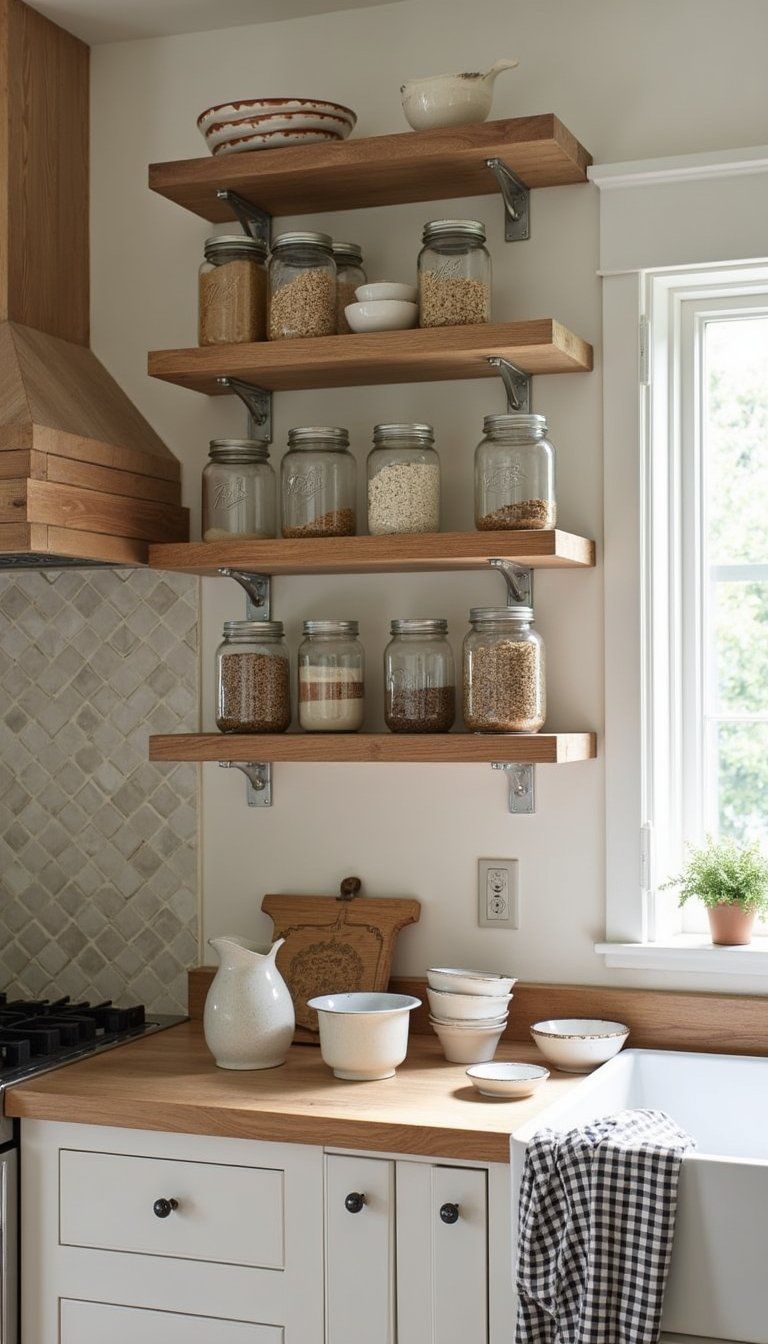
Kitchen shelves break every formula the moment you put “display” items on them. The rule here: if you don’t use it weekly, it doesn’t live on the open shelf. Decant flour, oats, and pasta into matching jars (a set of six mason jars runs about $8–10 and instantly looks styled), lean one cutting board at the back as your tall anchor, and let a stack of everyday bowls be the medium piece. We go deeper on the full system in our cheap kitchen decor ideas guide — the shelf rules there and here are the same triangle, just with jars. These are the shelf styling ideas that survive real cooking, which is more than most pretty kitchen photos can say.
Bathroom Shelves: The Tray Rule
Bathroom shelf styling ideas have one extra enemy — humidity — and one extra problem: bathroom shelves are small and full of ugly bottles. The fix is one tray: corral everything onto a tray or in a basket and the shelf instantly reads as styled instead of stored. Rolled hand towels are your free medium-height piece (a roll is about 4–5 inches across — perfect triangle math), and decanting cotton balls and swabs into one glass jar covers your small piece. More bathroom-specific moves live in our cheap bathroom decor ideas article.
Two quick bonus notes. A narrow hallway shelf or console follows the floating-shelf playbook — one hero group, nothing fussy — and our cheap hallway decorating ideas piece has the measurements for tight spaces. And if your taste runs dark, every formula above still works in black, brass, and deep green; our gothic home decor guide shows the moody version of the same math.
What to Buy (and What to Skip): A Per-Shelf Budget List
Once the $0 pass is done, most shelves need one or two gap-fillers, not a shopping spree. When the free pass leaves gaps, these are the shelf styling ideas worth actually spending on. Here’s what I buy, at real thrift and dollar-store prices:
- Picture frames, $1–3 thrifted — your cheapest tall anchor. Lean, don’t hang. A frame with a free printable in it beats most “art” under $20.
- Brass or wood candlesticks, $1–2 each — instant height, and they make the repeat-three-times color rule easy.
- Hardcover books, $0.50–$2 — buy them by size and color at library sales. You need stacks (2–3 books) more than you need reading material.
- Small ceramic vases and bowls, $2–6 — the medium piece. Chips on the back don’t count; turn them to the wall.
- Baskets, $1.25–$5 — Dollar Tree for small, thrift stores for big. Lidded ones hide ugly storage inside your 60%.
- One trailing faux plant, $1.25–$4 — a shelf edge with something spilling over it looks styled even when nothing else changes. (Real plant person? A pothos cutting in a jar of water is free.)
Total damage for one fully styled shelf: $5–15, and most of my shelves came in under $10 because the books and frames were already in the house. What to skip: word signs (they date a shelf faster than anything), matching boxed “decor sets” (zero personality, and the 10% personal rule dies), and anything under 3 inches tall that isn’t grouped — lone tiny objects just read as dust-collectors.
How to Style a Shelf in 10 Minutes, Step by Step
Everything above — the same shelf styling ideas, compressed into the order I actually do them:
- Empty and wipe the shelf. Two minutes. Non-negotiable.
- Place the tall anchor first — back-left or back-right, 60–75% of the opening height.
- Build the triangle: medium piece at least 3 inches shorter, small piece in front and lower.
- Check your thirds. Two zones filled, one zone breathing, 2–3 inch gaps between groups.
- Layer front to back. Leaning frame behind, small object in front of it. Depth is what makes a shelf look expensive.
- Step back six feet and squint. You should see triangles and gaps, not individual stuff.
- Remove one thing. Seriously. The last step of learning how to style a shelf is learning that the finished shelf is the one you edited, not the one you filled.
7 Shelf Styling Mistakes That Make Shelves Look Cheap
Nobody’s shelf fails because they picked the wrong vase. Most shelf styling ideas fail for one of these seven reasons — and every one of them is free to fix.
1. The lineup. Everything in one row, all the same height, like suspects. The triangle exists specifically to kill this.
2. Everything shoved against the back wall. Push items forward so fronts sit 1–2 inches from the shelf edge, and layer. A flat shelf is a boring shelf.
3. Too many tiny things. Ten 3-inch objects equal visual noise. Group small things on a tray or a book stack so they count as one medium piece.
4. No empty space. If 100% of the shelf is covered, nothing stands out. That empty third isn’t wasted — it’s the frame.
5. Dust. Unsexy, but a dusty styled shelf photographs and reads worse than a clean unstyled one. The 10-minute restyle starts with a cloth for a reason.
6. The rainbow spine explosion. Controversial, but a full ROYGBIV book wall fights every other color decision in the room. Sort books into loose color families, or turn the loudest spines to the back row. Your shelves, your call — just make it a decision instead of an accident.
7. Ignoring the wall behind. A painted or papered shelf back is the cheapest transformation there is (leftover paint, $0). The black-backed bookcase in our featured photo is doing half the styling work before a single object is placed.
Frequently Asked Questions
How much does it cost to style a shelf on a budget?
Most shelves cost $0–15 to style well. The $0 version uses books, frames, and bowls you already own, arranged with the triangle and thirds formulas. Honestly, the best shelf styling ideas are the free ones. If you need gap-fillers, thrifted frames ($1–3), candlesticks ($1–2), and hardcover books ($0.50–$2) cover almost every missing piece. Spending more than about $15 per shelf usually means you’re buying objects instead of fixing spacing.
What is the rule of thirds for shelf styling?
The rule of thirds is the shelf styling idea I reach for most. Divide the shelf into three equal zones. Fill two zones with object groups and leave the third mostly empty, with 2–3 inches of clear space between groups. On a 36-inch shelf that’s about 24 inches of styling and 12 inches of breathing room. The empty zone is what makes the filled zones look intentional.
How tall should the tallest item on a shelf be?
Aim for 60–75% of the shelf opening’s height. On a standard 12-inch bookcase opening, your tallest vase, plant, or leaning frame should be 7–9 inches. Then make the next piece at least 3 inches shorter, and the smallest piece 3–4 inches, so the three heights form a clear triangle.
How do you style a shelf without books?
Plenty of shelf styling ideas skip books entirely. Swap the books’ jobs to other objects: a lidded basket or storage box becomes the visual weight (the 60%), a leaning frame is the tall anchor, and a plant plus a candle makes the medium and small points of the triangle. Kitchen and bathroom shelves are styled without books all the time — jars, rolled towels, and trays do the same work.
How much empty space should a styled shelf have?
Around 30% of the shelf’s length. It’s the most common fix in all the shelf styling ideas here. If a shelf feels cluttered but you like everything on it, don’t rearrange — remove. Taking away a third of the objects and re-spacing the rest with 2–3 inch gaps fixes most “why does this look off” shelves in about two minutes.
How often should you restyle your shelves?
A light edit every season is plenty — swap one object, change the plant, rotate a frame. The formulas don’t change; only the 10% personal layer needs to move. If a shelf still makes you happy to look at, the correct amount of restyling is zero.
The Bottom Line
Good shelves aren’t about taste or money — these shelf styling ideas are about three formulas: a height triangle with at least 3 inches between levels, two filled thirds and one empty one, and groups of odd numbers in a 60/30/10 mix. Learn how to style a shelf with those numbers and you can fix any bookcase, floating shelf, or kitchen shelf in your house this weekend — most of them for free, the rest for the price of a pizza. For more whole-room systems like this, browse the rest of our Budget Home Decor guides, and start with whichever shelf is currently bothering you most.