
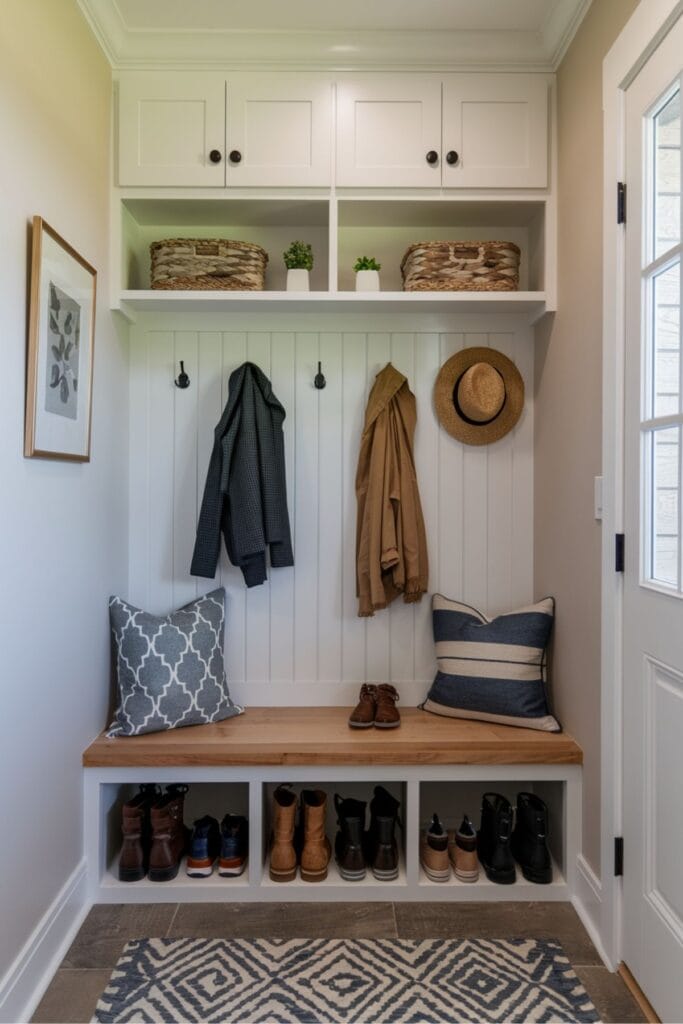
My first apartment had no entryway. None. The front door opened straight into the living room, and for a year my “system” was a bath mat with a shoe pile on it and a kitchen drawer where keys went to disappear. The fix, when I finally did it, cost $23: a $6 thrifted rug, four adhesive hooks for $11, a $3 tray and a $3 basket. That’s the part nobody tells you about small entryway ideas on a budget — the expensive-looking ones aren’t better. They’re just the same four pieces, bought pricier.
Below is the full system: the three measurements that decide whether a piece fits or blocks your life, a plan for apartments with literally no foyer, shoe and coat storage that stays under 12 inches deep, a no-drill renter setup, and complete small entryway ideas on a budget at $10, $25 and $50. Measure first. Shop second. That’s the whole order of operations.
Before You Buy Anything: The 3 Measurements That Decide Everything
None of the small entryway ideas on a budget below survive bad measurements, so take five minutes with a tape measure before the fun part.
The 36-inch rule. Keep 36 inches of clear walkway between your entry furniture and whatever faces it — a wall, a sofa, the kitchen counter. Thirty-six inches is the standard minimum hallway width in building codes, and it’s the difference between “cozy entry” and “shuffling sideways with groceries.” If a setup leaves you less than 36 inches, the setup is wrong, not the apartment.
The door swing. Most front doors are 32 to 36 inches wide, and that whole arc has to stay empty. Open your door fully and look at the quarter-circle it sweeps. Anything inside that arc — a bench, a shoe rack, a cute plant — will get hit, daily, forever. Mark the arc with painter’s tape before you buy a single thing.
The 12-inch depth budget. Anything that sits on the floor of a small entry gets a maximum depth of 12 inches, and 10 is better. Standard console tables run 14 to 16 inches deep, which is exactly why so many “perfect” entryway setups feel cramped by week two. Tape the footprint of a piece on the floor, live with the tape for a day, and walk past it with a laundry basket. If you clip it, shrink it.
Small Entryway Ideas on a Budget When There Is No Entryway at All
If your door opens into the living room or kitchen, you don’t have an entryway problem — you have a boundary problem. The fix is to draw the boundary yourself, with three cheap lines.
Line one: a rug. A washable rug at least as wide as the door, ideally the door width plus 12 inches, in a 2×3 or 3×5 foot size ($14–$25 for a machine-washable one). The rug is not decoration. It’s a rule: shoes stop at the rug’s edge. Guests read it instantly, kids read it in a week, and dirt stays on the washable thing instead of migrating across the room.
Line two: one perpendicular piece. A low bookcase, a slim console or an open clothing rack placed at a right angle to the wall beside the door fakes the wall your apartment forgot to build. Keep it under 12 inches deep and under 42 inches tall, so it divides without darkening. The faux-foyer below does it with a narrow console, a mirror and a basket — nothing in it costs real money.
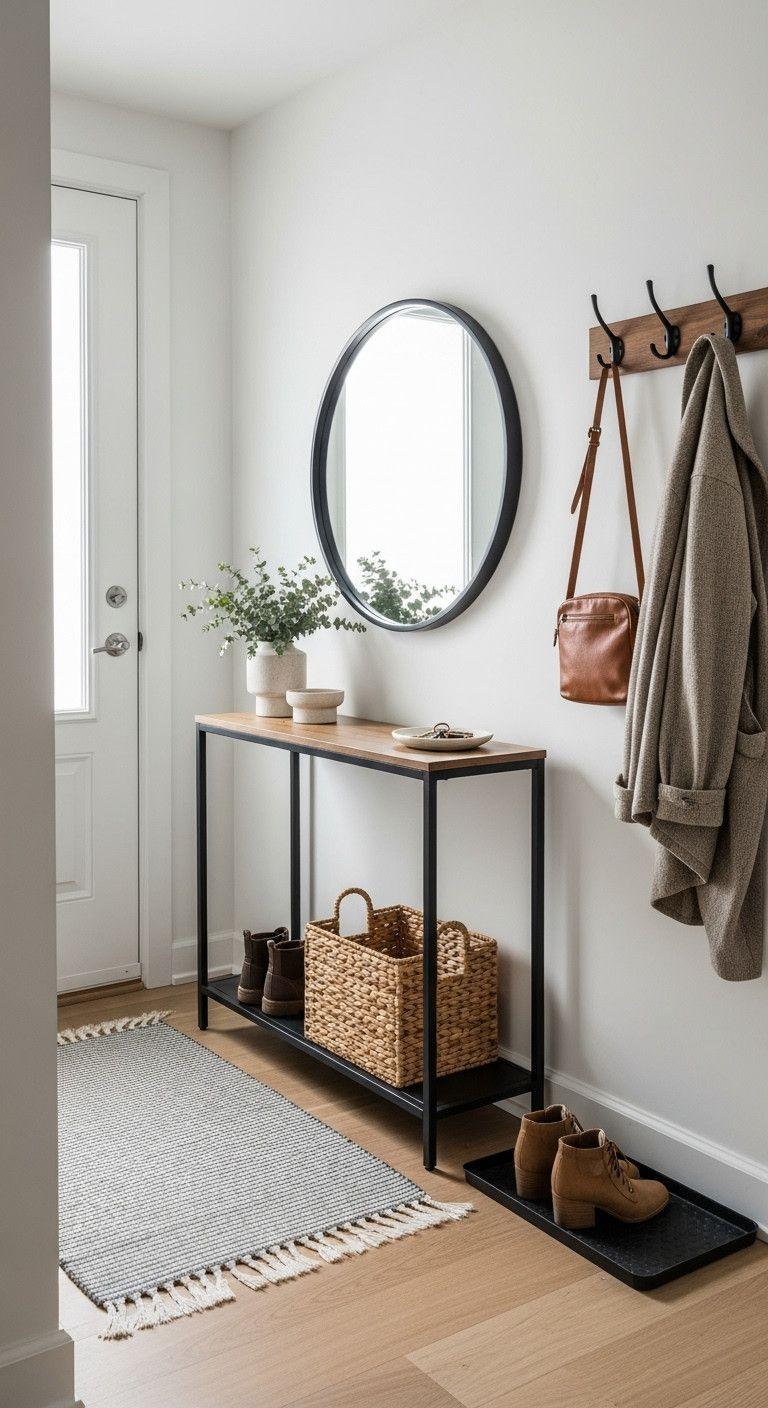
Line three: a painted zone. One quart of paint ($12–$15) in a rectangle or arch behind your hooks tells every eye “the entryway is here.” Renters can do the same trick with a peel-and-stick wallpaper panel or a large washable rug hung as a backdrop — anything that changes the wall’s texture inside a defined shape. This is the same one-corner-at-a-time thinking we use in our economy home decor guide: small defined zones, finished completely, beat a whole room done halfway.
The Landing Strip: 4 Pieces, in the Order Your Hands Need Them
Walk through your own front door in your head. Coat and bag come off first, then keys and wallet leave your pockets, then shoes. Your entryway should be arranged in that exact order, within arm’s reach of the door, and it takes only four pieces:
1. Hooks by the door ($11–$18). Four large adhesive hooks (about $11 a pack) or a 24-inch wooden peg rail with five hooks ($16–$22). This is where coats and bags land — not the sofa arm, not the floor.
2. A tray under the hooks ($3–$8). One shallow tray or dish on the nearest surface, or on a $12 floating shelf if there’s no surface. Keys, wallet, sunglasses. The tray is the entire system; when everything pocket-sized has one home, the morning key hunt dies. This landing-strip idea is sometimes called a “drop zone” — Shelterness has a nice tour of drop zones in bigger homes, and every one of them shrinks down to this same tray-plus-hooks core.
3. One basket per person ($6–$9 each). Shoes you wore today and will wear tomorrow go in your basket. Everything else lives in the bedroom closet. A two-pairs-per-person cap sounds strict until you realize it’s what every tidy entry you’ve ever admired is secretly doing — and it’s where most small entryway ideas on a budget quietly fail when nobody enforces it.
4. A mail answer ($9–$13). A wall pocket or two-slot sorter: one side “action,” one side “recycle.” Mail piles are not a storage failure, they’re a decision failure — give the junk a legal place to die the second it enters and the pile never forms.
Total for the full landing strip: roughly $25–$45, and it’s honestly 80% of what small entryway ideas on a budget can do for you. Everything after this section is refinement.
Shoe and Coat Storage That Stays Under 12 Inches Deep
The depth budget rules out most shoe furniture, so when you’re shopping small entryway ideas on a budget, sort by depth first and looks second. The pieces that actually fit:
Flip-front shoe cabinets. The IKEA TRONES is the classic: about 7 inches deep, roughly $40 for a two-pack, and it swallows six pairs in the footprint of a radiator. Screw it to the wall or don’t — at 7 inches deep with shoes inside, it stands fine. The top surface becomes a bonus shelf for the tray.
A boot tray ($12–$16). One low, lipped tray under the hooks catches slush, mud and wet sneakers so they never migrate onto the rug. In dry months it holds the everyday pair. Unglamorous, and I’d buy it before any decor.
Hooks at honest heights. Hang a coat rail at 66 inches if you wear long coats, everyday hooks at 60 inches, and a kids’ row at 42 inches. Hooks at 72 inches — picture-hanging height — are the silent cause of half the coat piles in America: nobody reaches that high with a bag on their shoulder. Space hooks 8 to 10 inches apart so coats hang beside each other instead of becoming one giant fabric lasagna, and give a heavy winter coat a hook of its own. Large adhesive hooks are rated around 4 pounds each, which handles a coat fine; a screwed peg rail is the stronger choice if your landlord allows two small holes (spackle erases them in minutes).
If your entry keeps going into a long narrow hall, the same depth rules apply down its whole length — our cheap hallway decorating ideas pick up exactly where this landing strip leaves off.
Renter Mode: The No-Drill Entryway That Leaves No Trace
Everything above can be done without a single screw. The renter kit, in order of usefulness:
Adhesive hooks, installed like you mean it. Wipe the spot with rubbing alcohol, press each hook for a full 30 seconds, then wait the whole 24-hour cure before hanging anything. Skipping the cure is why people think adhesive hooks don’t work. Large hooks hold about 4 pounds; the jumbo size is rated near 7.5 pounds — one per heavy coat.
Over-the-door hooks ($10–$14). A 5-hook rack over the back of the front door or a nearby closet door adds a full row of hanging in zero wall space. Check the gap above the door first: most racks need about 1/8 inch of clearance, and a strip of felt on the rack’s back stops the rattle.
A tension-pole coat rack ($28–$40) wedges floor-to-ceiling in a corner, holds coats like a hall tree, and leaves with you at lease end. A leaning ladder shelf does the same job with baskets on its rungs. The best small entryway ideas on a budget for renters are always the ones that move out with you. And for mirrors, large picture-hanging strips rated for 16 pounds hold a 24-inch mirror without a nail — more on that mirror next.
Mirrors and Light: The Two Tricks That Visually Double a Tiny Foyer
Most small entries have no window, one sad ceiling bulb, and a mirror budget of “whatever the thrift store has.” That’s enough.
The mirror. Go 24 to 30 inches across — smaller reads as a porthole, bigger won’t fit the wall you have. Hang the center at about 57 inches, and place it beside or across from your light source so it throws light back into the room, never facing the shoe basket (a mirror doubles whatever it reflects, clutter included). Thrifted mirrors run $8–$15; check the back for a solid wire or D-rings before you pay. Pound for pound, it’s the highest-impact piece in most small entryway ideas on a budget.
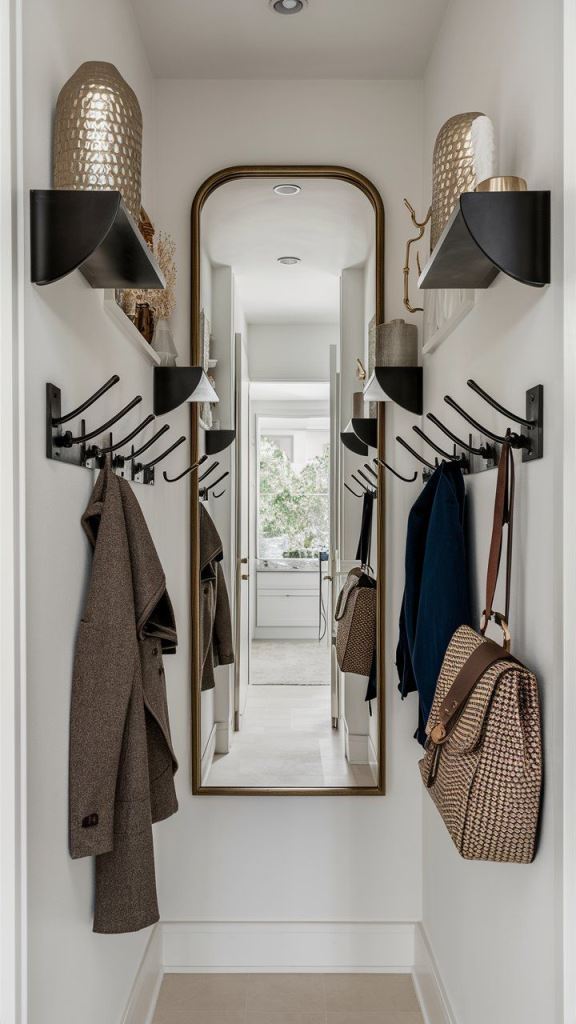
The light. Battery puck lights (about $11 for a 3-pack) stuck above the mirror or under a shelf make a windowless entry feel intentional instead of cave-like. A plug-in sconce with a cord cover runs $18–$25 and needs no electrician. Whatever you use, pick warm bulbs in the 2700–3000K range; a cold blue-white bulb is why so many small entries feel like a dentist’s office. And when you redo this corner for the season, our fall home decor on a budget guide has the rug-and-textile swaps that warm an entry up for winter.
Small Entryway Ideas on a Budget at $10, $25 and $50
Three honest shopping lists, depending on where you’re starting. Prices are typical discount-store and thrift prices as of fall 2026.
The $10 fix — behavior only. A thrifted tray ($2–$3), one thrifted basket ($3), and a dollar-store over-door hook strip ($4). No rug, no mirror — just a legal home for keys, shoes and coats. This tier fixes the mess, not the look, and for a lot of apartments that’s the whole battle.
The $25 fix — the zone appears. A washable 2×3 rug ($14), a 4-pack of large adhesive hooks ($8) and the $3 thrifted tray. Now the entry reads as a place instead of a spill, shoes stop at the rug, and coats leave the sofa alone.
The $50 fix — the full landing strip. The $25 setup, plus a 24-inch mirror ($15 thrifted, or about $25 new) and one basket per person ($6–$9). Mirror plus rug plus hooks is the trio every “after” photo you’ve ever saved is built on. If you have $50 and a free Saturday, this is the version I’d do — and did, twice, in two different apartments.
7 Mistakes That Make a Small Entryway Feel Even Smaller
1. The 16-inch console. Standard-depth furniture in a 12-inch world. Measure depth first; it’s the spec that matters and the one nobody checks.
2. Hooks at picture height. Hooks at 72 inches get admired, not used. Sixty inches for adults, 42 for kids.
3. A rug smaller than the door. A 18×30-inch mat in a 36-inch doorway catches one foot. The rug should be at least door-width, or the shoes will vote with their feet and land beside it.
4. The shoe tower. A tall rack that holds 14 pairs guarantees 14 pairs live at the door. Storage creates the pile it promises to solve. Cap the pairs, not the rack size.
5. No tray. Skip the $3 tray and mail, keys and receipts will colonize every flat surface within a week. It is always the tray. Buy the tray.
6. A mirror facing the clutter. Mirrors double what they reflect. Face yours toward light or art, not toward the shoe basket.
7. Five decorative nothings. A tiny entry can carry exactly one pretty thing on top of the functional setup. Five small decorations read as clutter at this scale; one good one reads as style.
Frequently Asked Questions
What should I put in a small entryway?
Four things, in this order: hooks for coats and bags, a tray for keys and wallet, shoe storage under 12 inches deep (a flip-front cabinet or one basket per person), and a mirror. That’s the complete kit behind most small entryway ideas on a budget — decor comes after those four, if there’s room.
How do I create an entryway in an apartment with no foyer?
Draw the boundary yourself: a washable rug at least as wide as the door, one slim piece placed perpendicular to the wall to fake a foyer wall, hooks and a tray on the nearest wall, and — if you can — a painted rectangle or peel-and-stick panel behind the hooks to mark the zone. The entry becomes a place because you defined it, not because the floor plan did.
How deep should an entryway console table be?
Ten to twelve inches deep, maximum. Standard consoles run 14–16 inches and eat the walkway. Whatever you place, keep 36 inches of clear passage in front of it — that’s the 36-inch rule, and it’s the fastest way to tell whether a piece belongs in a small entry.
Are adhesive hooks strong enough for winter coats?
Yes, with conditions. Large adhesive hooks are rated around 4 pounds each and jumbo hooks near 7.5 pounds — one winter coat per hook, not three. The install decides everything: clean with rubbing alcohol, press 30 seconds, and wait the full 24-hour cure before hanging. If your landlord allows small screw holes, a wooden peg rail is still the strongest cheap option.
How much does a small entryway makeover cost?
Less than most people guess. A working setup built from small entryway ideas on a budget runs about $25 (rug, hooks, tray), a full landing strip with a mirror and baskets lands near $50, and even the $10 thrifted version fixes the daily mess. The furniture-free versions work because the system matters more than the stuff.
How do I keep a small entryway tidy once it’s set up?
Two habits: a two-pair shoe cap per person, and a 60-second reset when you come home — shoes in the basket, keys in the tray, mail into the sorter. The setup fails only when an item has no legal home, so if something keeps landing on the floor, it needs a hook or a basket, not a lecture. The small entryway ideas on a budget that last are boring on purpose.
Start With the Tray Tonight
If you do one thing after reading this, find a tray — a plate, a shallow box lid, anything — and put it where your keys should live. Small entryway ideas on a budget are mostly that tray, repeated: one defined home per category, sized to the space you actually have. The rug, the hooks at 60 inches, the 7-inch shoe cabinet, the thrifted mirror — each is just the tray idea at a different scale.
And when this corner is working, the rest of the apartment gets easier, because the entry is where clutter enters the house. You’ll find more one-corner systems in our Budget Home Decor collection — every one of them is built the same way as these small entryway ideas on a budget: measure honestly, spend on the pieces that change behavior, skip the rest.