
Last updated: November 2026
My best thrift find cost $4. A squat brass lamp with a dented shade, buried behind a stack of chipped mugs at a church sale. I almost walked past it.
Three years later it still sits on my nightstand, and it still gets more compliments than anything else in the room — including the things I paid ten times more for. That’s the whole game of thrift store decor finds: a $4 lamp beats a $40 lamp when the $4 one has weight, shape, and a story.
Thrift store decor finds are secondhand home pieces — brass, solid wood, ceramics, glass, and textiles — bought at charity shops, estate sales, and flea markets, then styled as-is in your home. You buy for material and shape, not for the finish, and you skip anything that smells, wobbles, or needs a workshop.
This guide is a hunting list, not a project list. Nothing here needs paint, power tools, or a free weekend. If you do want to transform a find once it’s home, my upcycled home decor ideas guide picks up where this one stops.
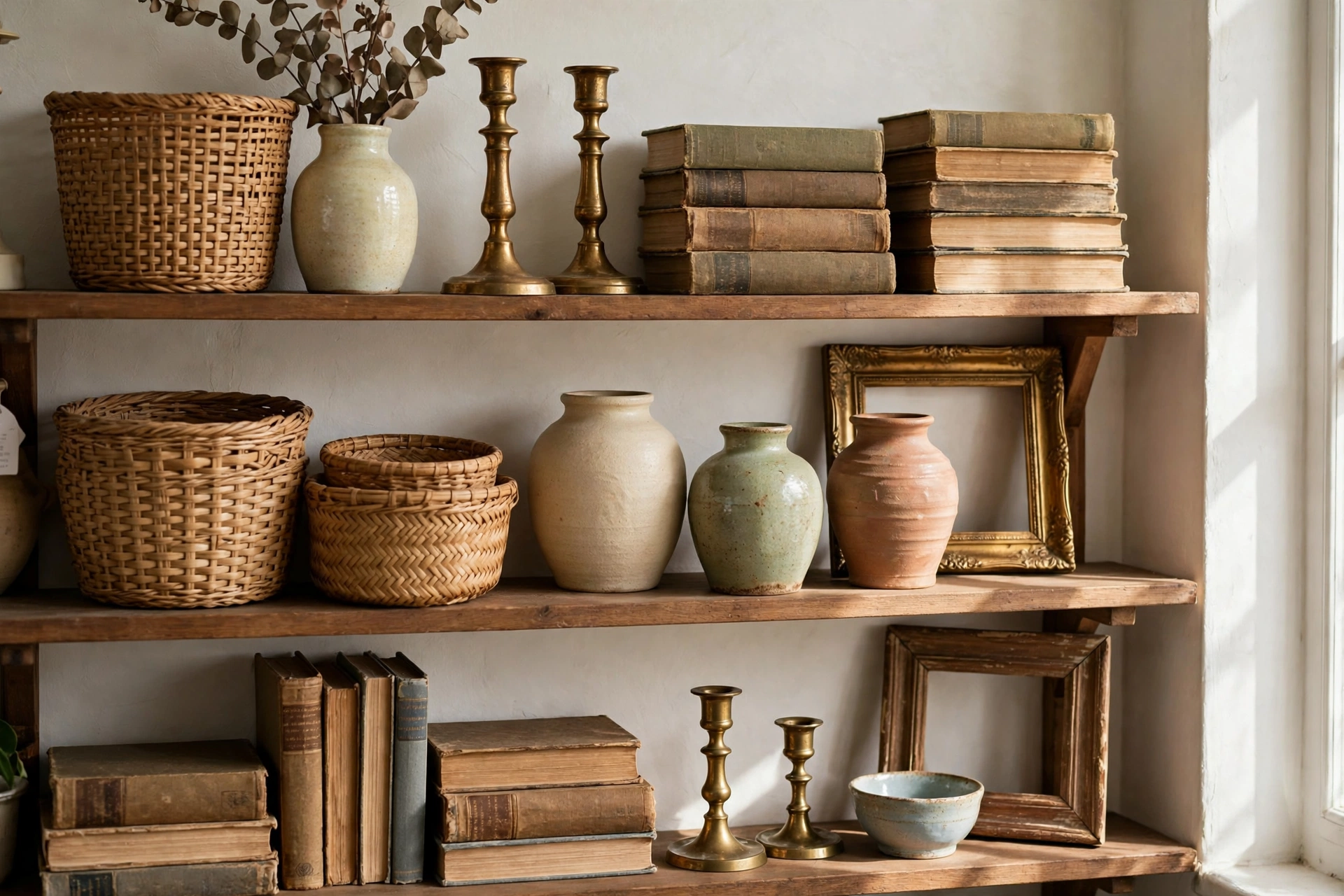
What Counts as a Thrift Store Decor Find?
A thrift store decor find is any piece that earns its spot fast: solid wood, real brass, heavy ceramics, good glass, or textiles. According to the EPA’s Renovation, Repair and Painting Rule (2008), paint on furniture made before 1978 may contain lead — so a painted dresser is a buy, but test the paint before you sand it.
The best thrift store decor finds share one trait, and it isn’t price. It’s material. A brass candlestick with tarnish is a $2 win, while a shiny plastic lamp that only looks like brass is clutter you paid for. Weight tells the truth. Pick it up: if it feels light for its size, put it back.
Here’s the thing: the ugliest piece in the store is often the best buy. A filthy brass tray for $2 cleans up to look like a $40 one, while the pretty, clean vase is usually priced like one, because the person who tagged it knew what they had.
Here’s what nobody tells you about thrifting: the store rewards patience and punishes impulse in the same trip. I once carried home a velvet armchair that smelled faintly of a basement, convinced I’d air it out. It sat in my garage for four months before I gave it back, lighter by $25 and wiser by one very smelly lesson.
This guide works best if you shop with a short list and a tape measure. It won’t help if you walk in hoping the store tells you what you need, because it will — and you’ll come home with a ceramic clown and no lamp. One honest note on scope: every price here is a U.S. thrift-store range from my own runs in 2026, so treat each number as a cap, not a quote.
How to Hunt: My 5-Step Saturday Routine
Most thrift store decor finds hide in plain sight, and the shoppers who find them aren’t lucky — they’re systematic. My routine takes about an hour, and it works at a charity shop, an estate sale, or a flea market stall.
1. Measure first — write down the three gaps you’re filling and carry a tape measure. 2. Walk the whole store once, fast, and note what catches your eye. 3. Go back slowly to the pieces you flagged. 4. Run the three checks: knock for solid material, open every drawer and door, smell it up close. 5. Buy only what has a spot waiting at home.
Go early. Weekday mornings are the calmest, and Saturday just after opening is when the week’s new stock is still on the shelves. The weeks after Christmas and after spring cleaning are the richest, because that’s when whole households get cleared out in one go. Ask the staff when new stock goes out — most stores restock on certain weekdays, and the staff will usually just tell you. Carry one colour to match — cream, sage, brass, warm wood — and let it filter every decision.
According to the U.S. Consumer Product Safety Commission, recalled products such as cribs, car seats, and old baby gear should never be resold or bought secondhand. The same caution applies to anything safety-critical in the decor aisles: cracked lamp sockets, frayed cords, and wobbly chairs aren’t bargains, they’re risks you carry home.
Here’s a take most thrift guides won’t print: stop buying the $2 vase. If you don’t have a shelf for it, a spot on the mantel, or a plant that needs a home, it’s not a bargain. It’s clutter with a receipt. The hunt works when the list leads and the eyes follow — never the other way round.
The 23 Things I Always Grab
Here are the 23 thrift store decor finds I grab whenever I see a good one, grouped by category so you can scan the aisle you actually need. Each one comes with a pay-up-to cap — the most I’d hand over — and the quick check that decides it. Everything below styles as-is.
Solid Wood Furniture
1. Solid wood nightstands — pay up to $15–$30 a pair. The single best buy in the store: three drawers, a flat top, a frame that doesn’t wobble. A sticking drawer is a $2 wax fix; a twisting frame is a lost cause.
2. Wood dressers and sideboards — pay up to $30–$60. The biggest piece you can carry home for the least money. Check the joints and drawers, and look for dovetail joints — interlocking “fingers” at the drawer corners.
3. Wood stools — pay up to $3–$10. Extra seating, a plant stand, a side table, and a step up to a high shelf, all in one small piece.
4. Single wooden dining chairs — pay up to $3–$8. Lone chairs get left behind when the set sells, so they run cheap. Sit on it and rock side to side.
Brass
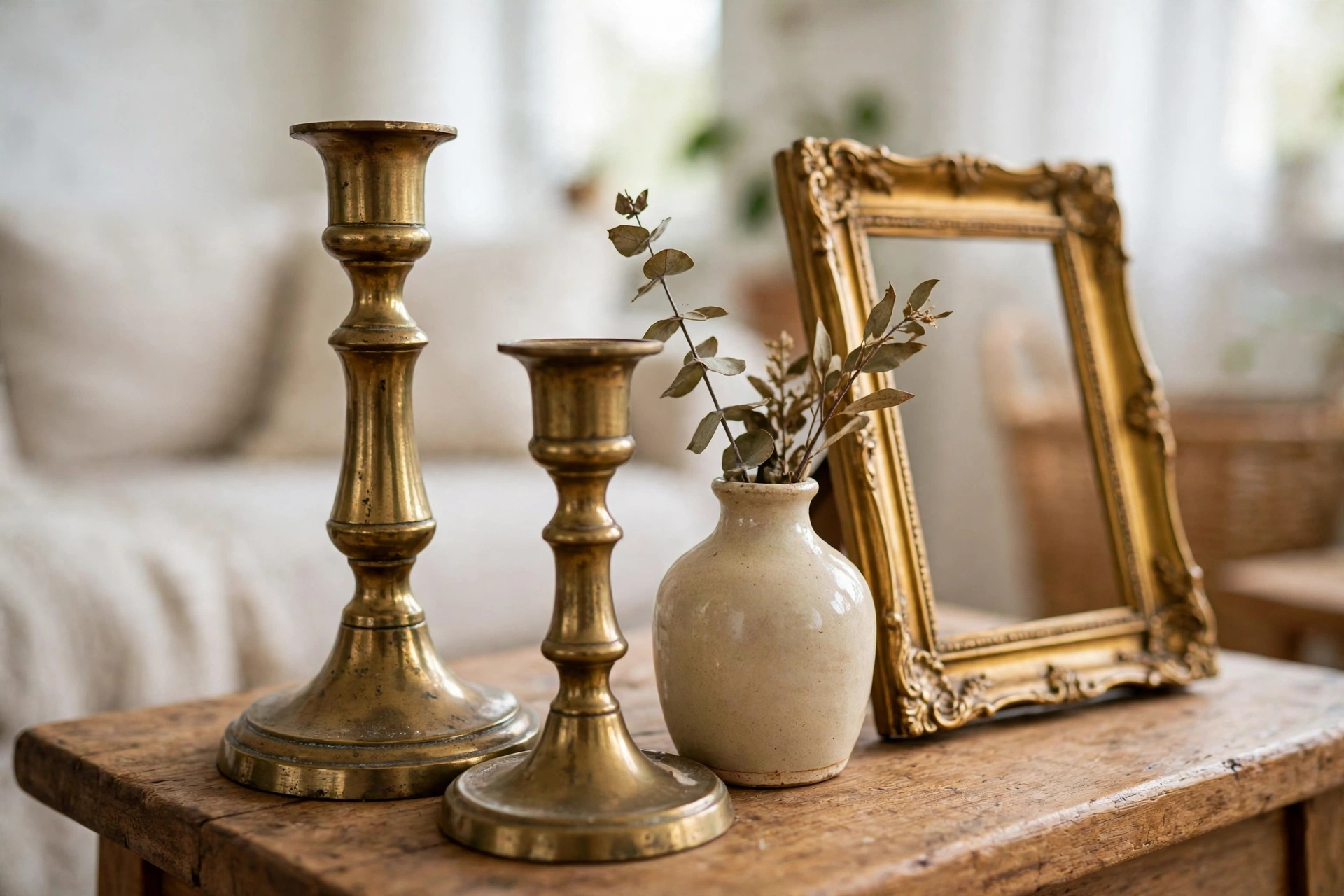
5. Brass candlesticks — pay up to $2–$4 each. Group five mismatched ones of different heights on a shelf and they read as collected. Tarnish is fine — it cleans up. If a magnet sticks, it’s plated steel, not solid brass.
6. Brass trays and bowls — pay up to $3–$8. A tray turns a messy coffee table into a styled one in five seconds: books, a candle, one small object, done. Heavy is good; light is painted plastic.
7. Brass or glass lamps — pay up to $5–$10 for the base. The shade is replaceable, the base is the value. Check the cord and socket, then budget $10–$15 for a fresh cream drum shade.
Ceramics and Glass
8. Ceramic vases — pay up to $2–$5 each. Buy them in threes — one tall, one round, one small — in cream, sage, or white. Run a finger around the rim for chips; a crack through the base is a leak waiting to happen.
9. Ceramic planters and pitchers — pay up to $3–$8. A heavy pitcher holds a full bunch of tulips without tipping, which most cheap vases can’t do. Planters need drainage or a saucer.
10. Glass pitchers and bottles — pay up to $2–$6. Small bottles grouped in threes make instant bud vases. Hold each piece up to the light for cracks, and keep chipped glass for display only.
Baskets, Crates, and Natural Fibre
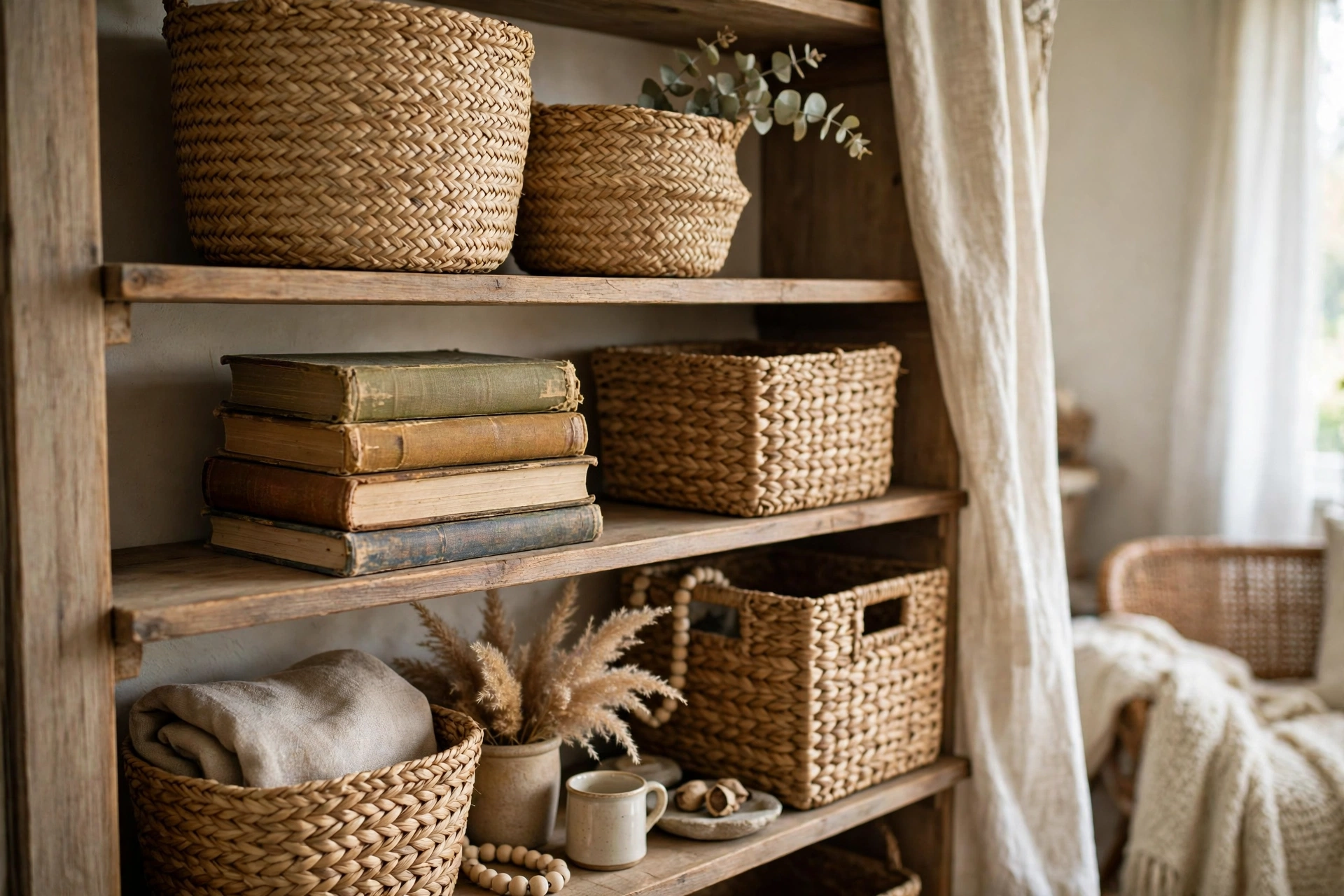
11. Woven floor baskets — pay up to $5–$12. One big basket holds throws, toys, or spare cushions in a natural texture that softens a white room. Lift it to your nose first — mildew smells like a damp basement and doesn’t wash out.
12. Woven trays — pay up to $2–$6. A tray corrals the clutter on a coffee table or entryway console with texture instead of plastic. If the weave is brittle or snapping, leave it.
13. Wooden crates — pay up to $3–$8. A crate is a shelf, a side table, and a storage box in one. Turned on its side beside an armchair, it holds records and magazines.
Frames, Mirrors, and Art
14. Wooden picture frames — pay up to $1–$5. The cheapest way to fill a blank wall. Look for real glass, a solid backing, and a size you actually need. Paint three frames one colour, hang them evenly, and you have a gallery wall — my gallery wall layout ideas guide has the exact spacing.
15. Gilded or metal frames — pay up to $3–$10. Carved wood, brass, or gilded finishes add the elegance a plain black frame never will. Buy for the frame as much as the picture — a good frame can hold your own print or a pressed flower.
16. Framed mirrors — pay up to $5–$15. A mirror is the only thrift find that makes a room bigger without moving a wall. Check the silvering: black spots around the edges mean the mirror is dying. Hang it across from a window.
17. Small oil paintings and prints — pay up to $3–$15. Moody old landscapes make white rental walls look deliberate, and leaning a painting on a dresser skips the nail entirely. Don’t love the art but love the frame? Keep the frame.
Books, Textiles, and Tabletop
18. Hardcover books and coffee table books — pay up to $1–$3 each. Under the shiny dust jacket, old hardcovers often have plain cloth covers in handsome colours. A stack of three under a lamp adds height wherever a plant sits too low.
19. Linen curtains and tablecloths — pay up to $3–$10. A pair of solid cream linen curtains costs a few dollars secondhand and hundreds new. Check every piece in daylight for stains, and stick to solid colours — a patterned curtain from someone else’s house will fight with your room.
20. Wool blankets and throws — pay up to $5–$15. A plaid wool blanket folded over one sofa arm adds the pattern a plain rental living room lacks. Read the care tag in the store, and skip anything with moth holes along the folds.
21. Wooden bowls and serving pieces — pay up to $3–$10. A wide, dark wooden salad bowl on a white counter is decor you get to eat. Wash wood by hand with mild soap and dry it right away — wood doesn’t like a long soak.
22. Vintage suitcases — pay up to $5–$15. Two hard-sided suitcases stacked beside a reading chair make a side table with a secret: inside is room for spare blankets. Open each case in the store — a musty smell is hard to get out.
23. Silver-plated trays and serving pieces — pay up to $3–$10. They hold rings by the bed, cotton pads in the bathroom, or matches on a mantel. Polish very gently so you don’t wear through the plating; tarnish on silver is character, not damage.
Honestly, if you only shop for three categories at first, make them brass, ceramics, and frames. They’re small, they’re cheap, and they change a room faster than anything else on this list.
The 7 Things I Always Leave Behind
A good thrift run is decided as much by what stays on the shelf as by what comes home, because the wrong piece costs you the money, the space, and the Saturday you spent carrying it. These seven are never worth it, no matter how cheap the tag says they are.
1. Particle board furniture. It swells when it gets wet, the edges crumble, and no paint fixes a swollen board. Knock on it first — solid wood sounds deep, particle board sounds hollow.
2. Stained or smelly upholstery. A chair with a mystery stain or a smoke smell is a problem you carry home, not a project. Check every seam with a flashlight for tiny dark spots — bed bugs hide there.
3. Mattresses, cribs, and car seats. Hygiene and safety standards change, and older pieces may have been recalled. These are the three things I always buy new, without exception.
4. Lamps with cracked sockets or frayed cords. A cracked socket is a fire risk, not a bargain. Leave it — unless you’re ready to pay for a full rewire before you plug it in.
5. Chipped melamine and cracked drinking glass. A chip on melamine always grows, and the white core shows. A crack in a glass you drink from is not safe for daily use, full stop.
6. Anything that needs “someday.” If a piece needs more than an afternoon of work, it will live in your garage forever. The best thrift store decor finds earn their spot on day one.
7. The matching furniture set. It looks like a showroom, costs more than a mixed set, and teaches you nothing about your own taste. Buy the good pieces one at a time instead.
Pay-Up-To Caps: What Each Category Is Worth
Thrift prices are local and one-off, so forget exact prices — what matters is the ceiling. If a tag is above the cap, walk away; another one will turn up next week. This table is the whole pricing system for thrift store decor finds in one place. Print it, screenshot it, or save it to your phone before your next run.
| Category | Pay up to | What new costs | Why thrift wins |
|---|---|---|---|
| Wood nightstands (pair) | $15–$30 | $120–$300 | Solid wood, dovetail joints |
| Wood dressers & sideboards | $30–$60 | $300–$800 | Biggest piece, least money |
| Wood stools & single chairs | $3–$10 | $40–$120 | Real wood, endless uses |
| Brass candlesticks (each) | $2–$4 | $12–$25 | Solid brass, cleans up |
| Brass trays & bowls | $3–$8 | $25–$60 | Weight and patina |
| Brass or glass lamps | $5–$10 | $40–$90 | Base is the value |
| Ceramic vases (each) | $2–$5 | $15–$40 | Glaze that lasts decades |
| Ceramic planters & pitchers | $3–$8 | $20–$50 | Heavy, handmade feel |
| Glass pitchers & bottles | $2–$6 | $15–$35 | Pressed-glass detail |
| Woven floor baskets | $5–$12 | $30–$80 | Natural fibre, storage + decor |
| Woven trays & crates | $2–$8 | $15–$45 | Texture new stores fake |
| Wooden & gilded frames | $1–$10 | $15–$60 | Real glass, solid joints |
| Framed mirrors | $5–$15 | $50–$150 | Doubles light and space |
| Small art & prints | $3–$15 | $30–$120 | One of a kind, framed |
| Hardcover & coffee table books | $1–$3 | $15–$50 | Cloth covers, real content |
| Linen curtains & tablecloths | $3–$10 | $60–$200 | Real linen, softened by age |
| Wool blankets & throws | $5–$15 | $50–$150 | Wool outlasts acrylic |
| Wooden bowls & serving pieces | $3–$10 | $20–$60 | Solid wood, warm grain |
| Vintage suitcases | $5–$15 | $60–$150 | Table + hidden storage |
| Silver-plated trays | $3–$10 | $30–$80 | Quiet luxury, pennies |
Two rules sit behind every number in that table. First, the cap assumes average condition — a chip or a wobbly leg drops the price, sometimes to zero. Caps are ceilings, not targets. Paying $2 for a $4-cap candlestick is the win, and paying the full cap for a perfect piece is still a win, because the new equivalent costs five to ten times more.
Thrift Store vs Estate Sale vs Flea Market vs Marketplace
Thrift stores win on price and frequency — decor for a few dollars, with new stock every week. Estate sales win on quality, with households of solid wood at their best on the last day, when prices drop by half. Flea markets win on statement pieces but cost more, and haggling is expected. Facebook Marketplace wins on big furniture, if you can collect it.
| Option | Best For | Key Benefit | Limitation |
|---|---|---|---|
| Thrift store | Small decor, weekly hunting | Cheapest prices, constant turnover | Hit or miss; no haggling |
| Estate sale | Quality furniture, full sets | Whole households, half price last day | Weekend only; early birds win |
| Flea market | Statement pieces, art, mirrors | Curated finds, haggling welcome | Higher prices, variable quality |
| Facebook Marketplace | Big furniture, local pickup | Searchable, negotiable, free delivery sometimes | Must collect; scams exist |
You don’t need all four. A charity thrift store within ten minutes of home, visited once a week, will build a whole room in two months. The other three are for the specific thing the thrift store never seems to stock: the dresser, the carved mirror, the set of dining chairs. Use them like specialist shops, not like a second hobby. The best thrift store decor finds reward the hunter who shops the right ground for the right piece.
The Cleaning and Safety Checklist
Most thrift store decor finds need a clean before they join your room — and it’s also the moment a dusty find starts to look like it belongs to you. Do it today. Clean it the same day you shop, not the weekend after.
Wood furniture: vacuum the dust, wipe with mild wood soap in warm water on a damp — not wet — cloth, and dry right away. Beeswax polish brings back the glow and hides small scratches.
Brass and metal: wash in warm soapy water, rinse, and dry. Gentle brass polish takes tarnish off in minutes — leave a little patina, since it looks more authentic. Lacquered brass needs soap and water only.
Ceramics and glass: warm soapy water, never the dishwasher for hand-painted or gilded pieces. Keep cracked glass for display only.
Linens and textiles: soak in cool water with gentle detergent, wash on a delicate cycle. An oxygen-based whitener brightens yellowed linen — never chlorine bleach on old lace. Dry flat or in the shade.
Baskets: warm soapy water, then air-dry in the sun. A hose spray gets into tight weaves. If the smell survives the sun, the basket goes back to the store.
Books: air them out for a day, pages fanned, with baking soda between the covers if the smell lingers. Never shelve a musty book next to clean ones.
The safety half of the list matters more than the cleaning half. Test for lead before sanding any painted piece made before 1978, and follow the EPA’s lead-safe guidance if the test comes back positive — or simply paint over it without sanding. Rewire any old lamp with a stiff or cracked cord before you plug it in, and never bring home upholstered furniture without checking every seam for bed bugs, because one infested chair costs more than a whole room of thrift store decor finds.
One small habit saves the most money: clean each thrift store decor find before you style it. A dusty brass tray looks like junk on a shelf and like a treasure on a clean one, and the only difference is ten minutes with a cloth.
How to Style Thrifted Finds So They Look Collected, Not Cluttered
This is where thrift store decor finds either look effortlessly collected or a little chaotic, and the difference is editing, not money. Aim for roughly one third old, two thirds new — newer, simpler pieces give older finds space to shine. Pick one statement piece per room: a carved dresser, a big gilded frame, a brass lamp with real presence.
Repeat colours and materials so the room reads as planned. If your thrifted lamp is brass, add one or two more brass touches in the same room — a frame, a candlestick, a tray. Group small finds in odd numbers: three ceramic vases of different heights on a tray look styled, while seven scattered across a shelf look like a collection waiting for a home. Leave empty space on every surface, and update the touch points — a new linen shade on an old base, or new knobs on an old dresser — to bridge old and new.
Thrift store decor finds suit some styles better than others, and that’s a feature, not a limit. They sit naturally in a farmhouse decor on a budget room, where wood, baskets, and worn brass are the whole language — and the same pieces make sustainable home decor brands buys feel less lonely when you do buy new. Brass candlesticks and small art also double as vintage Christmas decorations when December comes: the tray that holds keys in November holds pinecones and candles in December.
Thrift Store Decor Finds: Your Questions, Answered
Five questions, five straight answers.
What should I look for first at a thrift store? Start with thrift store decor finds that clean up easily and age well: lamps, frames, brass, glass, baskets, and solid wood. These six categories forgive beginners. Leave anything cracked, wobbly, or musty on the shelf.
How do you clean thrift store decor? Wipe hard surfaces with mild soapy water and dry them well. Clean textiles by the care tag, soak yellowed linen in an oxygen-based whitener, and air out books and suitcases for a day. Keep hand-painted ceramics out of the dishwasher, and skip anything whose smell survives a wash and a day in the sun.
Is it worth buying thrift store furniture? Yes — solid wood is the best value among thrift store decor finds, because a $15–$30 pair of nightstands or a $30–$60 dresser is built from materials that cost five to ten times more new. Buy solid wood, real brass, and heavy ceramics, and walk away from particle board and stained upholstery.
What shouldn’t you buy at a thrift store? Skip mattresses, cribs, and car seats for safety, skip anything with a cracked lamp socket or frayed cord, and skip stained or smelly upholstery. Painted furniture made before 1978 is fine to buy — just test for lead before you sand it.
When is the best time to go thrifting? Weekday mornings are the calmest time to shop, Saturday just after opening has the freshest stock, and the weeks after Christmas and spring cleaning bring the biggest hauls. Ask the staff which weekday new stock goes on the floor. The best thrift store decor finds go to the early shopper, so set the alarm.
Start With One Shelf
You don’t need a whole thrifted house. You need one shelf, one lamp, or one basket that makes a corner feel finished — and then you need the habit of looking. The best thrift store decor finds aren’t the cheapest ones. They’re the ones with a spot waiting at home, a price under the cap, and a material that will outlast the trend that made it cheap.
This weekend, pick one category from the list above — brass, ceramics, or frames — and go looking for just that. Measure the spot first, carry the cap in your phone, and come home with one good piece instead of five maybe-pieces. And when you’re ready to give a find a second life instead of styling it as-is, the upcycled home decor ideas guide is waiting.
Happy hunting. The $4 lamp is out there.